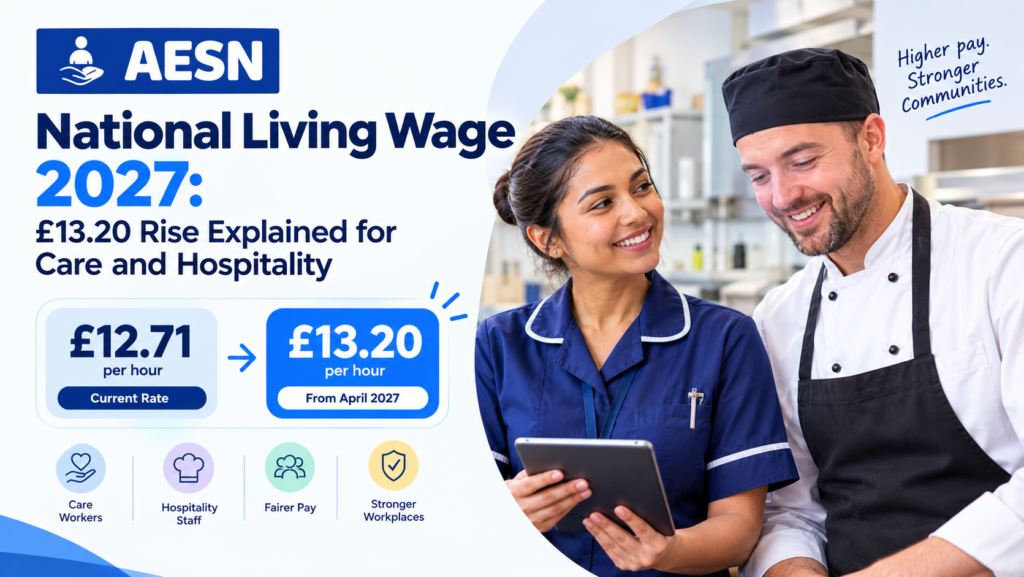
The National Living Wage is set to rise from £12.71 to £13.20 an hour on 1 April 2027. That is an increase of 49p, or about 3.9%, for workers aged 21 and over. The rate for 18 to 20-year-olds is expected to rise by the same percentage, from £10.85 to about £11.27.
The new rates were reported ahead of the Autumn Budget on 28 October 2026 and are expected to be confirmed by the Chancellor alongside it. For care and hospitality employers, the change sets next year’s pay floor. It affects staffing budgets, rotas, agency charge rates and pay differentials. For healthcare assistants, support workers, chefs and front-of-house staff, it sets the minimum you should see on your payslip from April.
This guide explains the National Living Wage 2027 rates, who gets them, what they cost employers and how to stay compliant.
National Living Wage 2027 at a glance
| Rate | Now (from 1 April 2026) | From 1 April 2027 (expected) | Change |
|---|---|---|---|
| National Living Wage (21 and over) | £12.71 | £13.20 | +49p (3.9%) |
| 18 to 20 | £10.85 | about £11.27 | +42p (3.9%) |
| 16 to 17 | £8.00 | To be confirmed | – |
| Apprentice rate | £8.00 | To be confirmed | – |
| Accommodation offset (per day) | £11.10 | To be confirmed | – |
Current rates are from GOV.UK. The 2027 figures are as reported before the Budget.
What the rise means in pay
For a full-time worker on 37.5 hours a week, 52 weeks a year (1,950 hours):
- 21 and over: £24,784.50 a year now, rising to £25,740. That is £955.50 more before tax.
- 18 to 20: about £819 more a year before tax, if the £11.27 rate is confirmed.
- Part-time on 18.75 hours a week: about £478 more a year at the 21-and-over rate.
Take-home pay rises by less than this, because of Income Tax and National Insurance.
When does the minimum wage go up in 2027?
The new rates apply from 1 April 2027. That date was set in the government’s remit to the Low Pay Commission, which asked for recommendations by the end of October 2026.
The new rate applies to pay reference periods that start on or after 1 April 2027. If a weekly or monthly pay period began before 1 April, the old rate can apply until the next one begins. Check this with your payroll provider.
Why is the rise smaller than the last two years?
The 2027 rise is smaller than recent ones. In April 2026 the National Living Wage rose 4.1%, and the 18–20 rate rose 8.5%, according to Personnel Today.
Three points explain the change:
- The two-thirds target. The government asked the Low Pay Commission to keep the National Living Wage at two-thirds of median hourly earnings. Once that level is reached, rises track wider pay growth.
- The LPC’s earlier estimate. In spring 2026 the Commission’s central estimate for April 2027 was £13.18, within a range of £13.02 to £13.34. The reported £13.20 sits near that central estimate.
- Youth employment. Reports say the 18–20 rate will rise in line with the adult rate, not faster. That pauses the move to a single adult rate in this Parliament, after concern about youth unemployment. The government’s remit still commits to aligning the rates in time. Watch for the confirmed policy.
Who is entitled to the National Living Wage?
The National Living Wage is the minimum wage for workers aged 21 and over. You are entitled to it if you are a “worker”, whatever your contract type. That includes:
- Full-time and part-time employees.
- Temporary and agency workers.
- Workers on zero-hours or casual contracts.
- Workers on probation or trial shifts that count as work.
Genuinely self-employed people are not covered. Calling someone self-employed does not change their status if, in practice, they work as a worker.
Do agency workers get the National Living Wage?
Yes. Agency temps must be paid at least the minimum wage for their age from day one of an assignment. After 12 weeks in the same role with the same hirer, the Agency Workers Regulations also give a right to the same basic pay as comparable permanent staff.
For employers, the minimum wage rise feeds into agency charge rates from April. Agencies pass on the higher pay, plus the employer National Insurance, holiday pay and pension costs that go with it.
What the 2027 rise costs care and hospitality employers
The hourly rate is only part of the cost. Employer National Insurance and pension contributions rise with pay.
The table shows the yearly cost of one full-time worker (1,950 hours) at the National Living Wage. It uses 2026/27 thresholds: employer National Insurance of 15% above £5,000 a year (GOV.UK), and a 3% employer pension contribution on qualifying earnings above £6,240.
| Cost per full-time worker | At £12.71 | At £13.20 | Increase |
|---|---|---|---|
| Gross pay | £24,784.50 | £25,740.00 | £955.50 |
| Employer National Insurance | £2,967.68 | £3,111.00 | £143.32 |
| Employer pension (3%) | £556.34 | £585.00 | £28.66 |
| Total | £28,308.52 | £29,436.00 | £1,127.48 |
This is an illustration, not a quote. Holiday pay is already included in 52 paid weeks. It assumes 2026/27 thresholds stay the same in 2027/28. If the Budget changes them, the numbers will change.
Example: a care home with 30 full-time care assistants on the National Living Wage faces roughly £33,800 more in yearly staff costs from April 2027, before any change to differentials.
The knock-on effect on pay differentials
The bigger cost is often keeping the gap between grades. If a senior carer earns £13.40 today, the rise leaves them just 20p above a new starter. In hospitality, a supervisor or chef de partie can end up close to a kitchen porter.
Plan now for:
- How much of a gap you want between entry, experienced and senior roles.
- Whether night, weekend and bank holiday premiums still look fair.
- Whether your pay offer stands out against local care, retail and hospitality employers.
Care sector: specific minimum wage risks
Care employers face some compliance traps that do not apply in most other sectors. GOV.UK lists the most common causes of underpayment in its employer checklist.
Travel time in domiciliary care
Time spent travelling between care visits counts as working time for minimum wage purposes. Travel from home to the first visit, and from the last visit home, does not (GOV.UK).
If you pay per visit, check that total pay divided by visit time plus travel time still reaches £13.20 an hour from April 2027.
Sleep-in shifts
GOV.UK lists “failure to pay sufficient money for any time worked during a sleep-in shift” as a common cause of underpayment. Time spent awake and working during a sleep-in counts. Check your sleep-in rates against the new rate.
Training and handovers
Mandatory training, inductions, handovers and time waiting to start a shift at the workplace can all count as working time. Pay for them at or above the minimum wage.
Hospitality: specific minimum wage risks
Tips do not count towards minimum wage
Tips from customers cannot be used to top up basic pay to the minimum wage. Since October 2024, employers must also pass on all tips to workers fairly.
Uniform and other deductions
Deductions or payments for items connected with the job, such as uniforms, knives or safety shoes, cannot take pay below the minimum wage. A worker on £13.20 who pays for their own uniform may be underpaid.
Staff accommodation
If you provide live-in accommodation, only the accommodation offset can count towards minimum wage pay. Charging more than the offset can cause underpayment. The 2027 offset rate is not yet confirmed.
Unpaid trial shifts
A trial shift that involves real work is normally working time. Pay for it.
Employer checklist: preparing for April 2027
- Confirm the final rates on GOV.UK after the Budget.
- List every worker paid under £13.20, plus 18–20-year-olds under £11.27.
- Note birthdays. Workers who turn 21 or 18 move to a higher rate from the next pay reference period.
- Update payroll for pay periods starting on or after 1 April 2027.
- Review differentials for seniors, supervisors, team leaders and night staff.
- Audit working time: travel between visits, sleep-ins, training and handovers.
- Check deductions for uniform, equipment, accommodation and salary sacrifice.
- Ask your agency for revised charge rates for temporary staff from April.
- Update job adverts that show an hourly rate.
- Keep records. You must keep records showing you paid the minimum wage.
Candidates: what the rise means for you
If you work in care or hospitality, here is what to know:
- Check your rate in April. From 1 April 2027 you should be paid at least £13.20 an hour if you are 21 or over, once the rate is confirmed.
- Count all your hours. In home care, travel between visits counts towards minimum wage.
- Check deductions. Uniform and other job-related costs must not take your pay below the minimum.
- Temps are covered too. Agency workers get the minimum wage from day one.
- Ask questions. If you think you are underpaid, raise it with your employer or agency first. You can also contact Acas on 0300 123 1100.
The minimum wage is a floor, not a target. Many care and hospitality roles pay more for experience, qualifications, nights and weekends. Look at the total package: hours, travel, overtime and progression.
National Living Wage vs real Living Wage
The two are often confused:
- National Living Wage: the legal minimum for workers aged 21 and over, set by government. Expected at £13.20 from April 2027.
- Real Living Wage: a voluntary rate set by the Living Wage Foundation based on living costs. It is £14.10 across the UK and £15.45 in London for 2026/27.
The Living Wage Foundation says a full-time worker on the new National Living Wage would earn over £1,700 a year less than on the real Living Wage.
Frequently asked questions
What will the National Living Wage be in 2027?
The National Living Wage is expected to be £13.20 an hour from 1 April 2027, up from £12.71. Confirm the final rate on GOV.UK.
What will the minimum wage be for 18 to 20-year-olds in 2027?
The 18 to 20 rate is expected to rise from £10.85 to about £11.27 an hour, a rise of about 3.9%.
When does the new minimum wage start?
The new rates start on 1 April 2027. They apply to pay reference periods beginning on or after that date.
Do agency workers get the National Living Wage?
Yes. Agency and temporary workers aged 21 and over must be paid at least the National Living Wage from their first shift.
Does travel time count for minimum wage in care work?
Travel between care visits counts as working time. Travel from home to the first visit and from the last visit home does not.
Can tips be used to pay the minimum wage?
No. Tips from customers do not count towards minimum wage pay.
Who enforces the minimum wage?
The Fair Work Agency, launched in April 2026, now enforces minimum wage rules. Employers who underpay must pay arrears and can face penalties and public naming.
How AESN can help
AESN supplies temporary and permanent staff across healthcare, care and hospitality, including healthcare assistants, support workers, chefs, and kitchen and front-of-house teams. We can help you:
- Plan your 2027 temporary staffing budget with clear, up-to-date charge rates.
- Cover rota gaps quickly with compliant, vetted temporary staff.
- Recruit permanent staff at a pay level that attracts and keeps good people.
Looking for work? Browse our current vacancies and register with AESN.
Contact AESN to talk about your staffing needs for 2027.