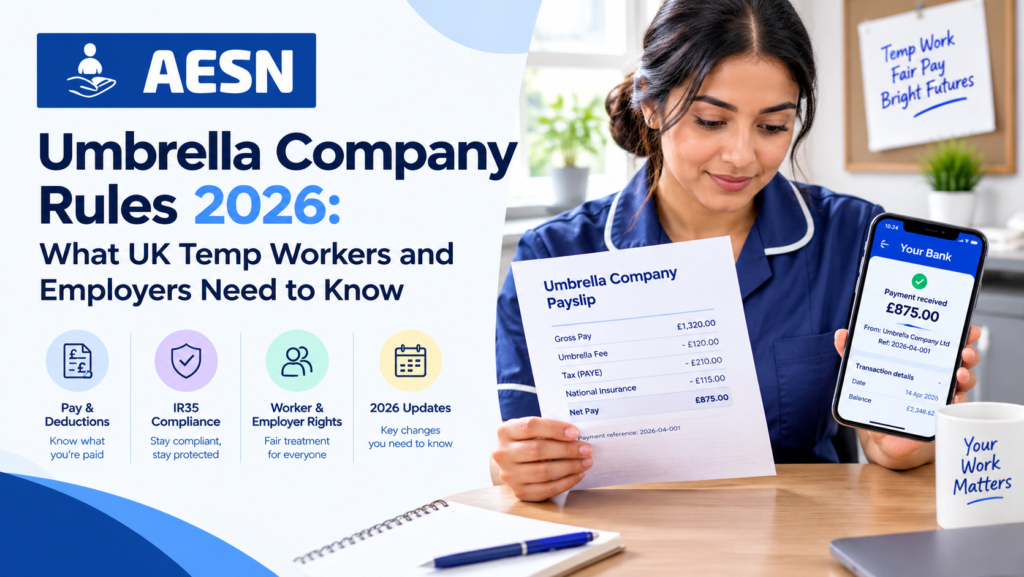
If you are starting a temporary job this winter in a care home, hospital ward, hotel kitchen or restaurant, you may be asked to get paid through an umbrella company. You may have heard that the umbrella company rules changed in 2026. They did, and more changes are expected in 2027.
This guide explains in plain English what an umbrella company is, what changed on 6 April 2026, how to read an umbrella payslip and which warning signs to look out for. It also covers what care and hospitality employers who use agency staff should check now.
What is an umbrella company?
An umbrella company is a business that employs temporary workers and pays their wages through PAYE. GOV.UK describes it as “a business often used by recruitment agencies to pay temporary workers”.
The umbrella company does not find you work. The recruitment agency does that. The umbrella company becomes your employer for pay purposes. It runs your payroll, deducts tax and National Insurance, and pays you.
Government estimates suggest around 700,000 people work through roughly 500 umbrella companies in the UK.
How do umbrella companies work?
A typical umbrella supply chain has four parties:
- The client (hirer): the care home, NHS trust, hotel or restaurant where you do the work.
- The recruitment agency: finds you the assignment, collects timesheets and invoices the client.
- The umbrella company: employs you, receives money from the agency and runs your payroll.
- You, the worker: you do the shifts, submit timesheets and receive your pay.
The money moves in this order. You submit your timesheet, the agency invoices the client, and the agency pays the umbrella company an agreed rate for your hours. The umbrella company then makes its deductions and pays you.
One point catches many people out. The rate quoted for an umbrella assignment is often not your gross pay. It usually has to cover the umbrella company’s costs before your own tax is taken off.
What changed on 6 April 2026?
From 6 April 2026, new PAYE rules apply to labour supply chains that include an umbrella company. They apply to payments made on or after that date, whenever the contract started.
In short, if an umbrella company fails to pay the PAYE income tax and National Insurance due on your wages, HMRC can now recover it from someone else in the chain:
- The agency that holds the contract with the end client to supply the worker. Where there is more than one agency, this is the one with the direct contract with the client.
- The end client, where there is no agency in the chain.
This is called joint and several liability. Legal commentary on the rules notes there is no “reasonable care” defence. An agency can be liable even if it did not know about the problem and had carried out checks.
The rules were designed to tackle non-compliant umbrella companies, including tax avoidance schemes and “mini umbrella company” fraud. The upshot for workers is that agencies and clients now have a strong financial reason to use only compliant umbrella companies. You should see fewer “too good to be true” pay offers as a result.
What the April 2026 rules do not change
- Your umbrella company is still your employer, and you still have employment rights with it.
- You are still responsible for making sure the right tax is paid. GOV.UK warns that this applies even when you are employed.
- The rules do not set a cap on umbrella margins or other deductions.
What changes are expected in 2027?
A second, separate reform is on the way under the Employment Rights Act 2025.
The Act widens the legal definition of an “employment business” in the Employment Agencies Act 1973 to include businesses that handle a worker’s pay. That brings umbrella companies into the same regulatory framework as recruitment agencies. The government’s factsheet says this is expected to start in 2027, together with amended Conduct Regulations.
Once it is in force, the Fair Work Agency will be able to regulate umbrella companies as it does other parties in the agency supply chain.
The Department for Business and Trade consulted from 6 February to 1 May 2026 on how the rules should apply. The consultation covered pay transparency, security for agency workers and giving workers more choice in how they are engaged and paid. At the time of writing (26 October 2026), the government says it is still analysing responses. We will update this guide when the final rules are published.
| Change | Date | Who it affects most | Status |
|---|---|---|---|
| PAYE joint and several liability for umbrella supply chains | 6 April 2026 | Agencies and end clients | In force |
| Umbrella companies brought within employment business regulation | Expected 2027 | Umbrella companies, agencies, workers | Detail pending consultation response |
| Fair Work Agency enforcement over umbrella companies | When the 2027 definition starts | Umbrella companies | Expected |
Your rights when you are paid through an umbrella company
According to GOV.UK, if an umbrella company employs you, you have the same employment rights as other employees. In practice, that means:
- A written employment contract from the umbrella company.
- At least the National Minimum Wage or National Living Wage, paid on time and in full. From 1 April 2026 the rates are £12.71 an hour (21 and over), £10.85 (18 to 20) and £8.00 (under 18 and apprentices).
- A payslip for every payment.
- Automatic enrolment in a workplace pension if you are eligible.
- Holiday pay, either rolled up into each payslip or calculated over a 52-week reference period and paid when you take leave. Ask your umbrella company which method it uses.
- Statutory Sick Pay if you qualify. Day-one SSP rules apply from April 2026, and our Statutory Sick Pay 2026 guide explains them.
The Key Information Document
Before you start, the agency must give you a Key Information Document. Under GOV.UK guidance it should show:
- which umbrella company the agency uses for the work
- the minimum assignment rate paid to the umbrella company
- what the umbrella company will deduct
- your minimum gross pay
If you have not received one, ask for it before your first shift.
How to read an umbrella company payslip
Umbrella payslips confuse many people because two sets of deductions are involved.
Step 1: employer costs come out of the assignment rate. These usually appear on a separate reconciliation statement, not on the payslip itself:
- the umbrella company’s fee (the “margin”)
- employer National Insurance
- employer pension contributions
- holiday pay, if it is held back or rolled up
- the Apprenticeship Levy, where it applies
What is left is your gross pay.
Step 2: employee deductions come out of gross pay. These are the same as in any PAYE job:
- Income Tax
- employee National Insurance
- your pension contributions
- student loan repayments, if they apply
- any other deductions you agreed to, or that are required by law
What is left is your net (take-home) pay.
| Stage | What it includes | Where to find it |
|---|---|---|
| Assignment rate | The total the agency pays the umbrella company for your hours | Key Information Document, reconciliation statement |
| Employer deductions | Margin, employer NI, employer pension, holiday pay, Apprenticeship Levy | Reconciliation statement |
| Gross pay | Assignment rate minus employer deductions | Payslip |
| Employee deductions | Income Tax, employee NI, pension, student loan | Payslip |
| Net pay | What reaches your bank account | Payslip and bank statement |
Payslip checklist
- My gross pay matches or beats the minimum gross pay in my Key Information Document
- My hourly pay works out at no less than the minimum wage for my age
- Tax and National Insurance match what my HMRC personal tax account shows
- Pension contributions appear in my pension account
- I understand how my holiday pay is being paid
- The employer name and PAYE reference have not changed without explanation
- I have asked for a reconciliation statement if any figure is unclear
Keep copies of every payslip and statement. They are your evidence if something goes wrong.
Warning signs of a non-compliant umbrella company
GOV.UK lists these warning signs that an umbrella company may be involved in tax avoidance:
- You get a separate payment described as non-taxable, such as a “loan”.
- You receive more money than your payslip shows.
- You are paid by someone other than the umbrella company, and that payment has not been taxed.
- You are asked to sign an extra agreement alongside your employment contract.
- Your employer’s name or PAYE reference changes often without you asking. This can point to mini umbrella company fraud.
Be wary of offers that promise unusually high take-home pay. If an offer looks too good to be true, take your time and ask for full written details. HMRC can recover unpaid tax from you, and getting out of a scheme later is stressful and expensive.
Do I have to use an umbrella company?
Not always. How you are paid depends on the agency and the assignment. Some agencies pay temporary workers directly through their own PAYE payroll, and others use one or more umbrella companies. Before you accept work, ask:
- Will I be paid through the agency’s payroll or an umbrella company?
- If it is an umbrella, which one, and what will it deduct?
- What is my minimum gross pay and how often will I be paid?
- How is my holiday pay handled?
The 2026 consultation looked at giving workers more choice in how they are paid. The final rules have not been published, so check for updates before relying on any change.
What care and hospitality employers should check now
If you hire agency staff and an umbrella company is anywhere in the chain, the April 2026 rules matter. Where you engage workers without a UK agency in between, they matter even more, because you may be the party HMRC pursues.
GOV.UK guidance for employment businesses and legal commentary point to these practical steps:
- Map your labour supply chain. List every agency you use and ask whether umbrella companies are involved.
- Keep supply chains short. Every extra link adds risk.
- Use agencies that carry out and record due diligence on umbrella companies. Checks include Companies House details, VAT registration, bank account names, employers’ liability insurance and accreditations.
- Review your contracts for warranties, indemnities, audit rights and information sharing on PAYE compliance. These will not stop HMRC recovering tax, but they may help you recover costs.
- Be cautious with unusually low charge rates. A rate that looks cheap can hide non-compliance further down the chain.
- Align HR, procurement and finance so nobody adds a new supplier without checks.
- Plan for 2027. Watch for the government’s consultation response and any new Conduct Regulations for umbrella companies.
Quick example
Illustrative scenario, not a real case. A residential care home books night-shift healthcare assistants through an agency. The agency pays the workers through an umbrella company. During a busy winter, the umbrella company stops paying over the PAYE it deducts.
Under the 2026 rules, HMRC can recover the unpaid income tax and National Insurance from the agency that contracts with the care home. If the care home had booked the workers through an overseas intermediary with no UK agency, the risk could fall on the care home itself. Either way, the workers’ own payslips and HMRC records are what reveal the problem. That is why the checklist above matters.
Where to get help
- Start with your umbrella company for any question about pay or deductions.
- Talk to your agency if your pay does not match the Key Information Document.
- Contact Acas, Citizens Advice or a trade union if the problem is not resolved.
- Report tax fraud or avoidance to HMRC online or through its fraud hotline.
- Use the GOV.UK pay and work rights complaints service for minimum wage, agency or working time issues.
Frequently asked questions
What are the umbrella company rules for 2026?
From 6 April 2026, if an umbrella company does not pay the PAYE tax and National Insurance due on workers’ pay, HMRC can recover it from the agency that contracts with the end client. If there is no agency, it can recover it from the end client.
Are umbrella companies being banned?
No. Umbrella companies remain legal. The 2027 changes are expected to regulate them in a similar way to recruitment agencies, not to ban them.
Will I pay more tax through an umbrella company?
Your own Income Tax and employee National Insurance are worked out in the same way as in any PAYE job. The difference is that employer costs, such as employer NI and the umbrella margin, are usually taken from the assignment rate before your gross pay is set.
Can the agency choose my umbrella company?
Agencies often have a list of approved umbrella companies. The Key Information Document must tell you which one is being used. Whether workers will get more choice depends on the 2027 rules, which are still being finalised.
Does the umbrella company pay my holiday pay and sick pay?
Yes. As your employer, the umbrella company is responsible for holiday pay and, if you qualify, Statutory Sick Pay. Check your contract and payslip to see how holiday pay is handled.
What happens if my umbrella company goes bust or stops paying?
Raise it with your agency straight away and keep all your payslips and timesheets. Get advice from Acas or Citizens Advice. If you suspect tax fraud, report it to HMRC.
How AESN can help
AESN supplies temporary and permanent staff across healthcare, care, hospitality and other sectors.
- Candidates: ask your AESN consultant how you will be paid and what to expect on your payslip before your first shift. Browse current roles on our jobs page or apply online.
- Employers: if you need reliable temporary or permanent staff this winter, talk to us about your requirements and how our candidates are engaged.
Questions about temp work, pay or staffing? Contact the AESN team today.