National Living Wage 2027: £13.20 Rise Explained for Care and Hospitality

The National Living Wage is set to rise from £12.71 to £13.20 an hour on 1 April 2027. That is an increase of 49p, or about 3.9%, for workers aged 21 and over. The rate for 18 to 20-year-olds is expected to rise by the same percentage, from £10.85 to about £11.27. The new rates were reported ahead of the Autumn Budget on 28 October 2026 and are expected to be confirmed by the Chancellor alongside it. For care and hospitality employers, the change sets next year’s pay floor. It affects staffing budgets, rotas, agency charge rates and pay differentials. For healthcare assistants, support workers, chefs and front-of-house staff, it sets the minimum you should see on your payslip from April. This guide explains the National Living Wage 2027 rates, who gets them, what they cost employers and how to stay compliant. National Living Wage 2027 at a glance Rate Now (from 1 April 2026) From 1 April 2027 (expected) Change National Living Wage (21 and over) £12.71 £13.20 +49p (3.9%) 18 to 20 £10.85 about £11.27 +42p (3.9%) 16 to 17 £8.00 To be confirmed – Apprentice rate £8.00 To be confirmed – Accommodation offset (per day) £11.10 To be confirmed – Current rates are from GOV.UK. The 2027 figures are as reported before the Budget. What the rise means in pay For a full-time worker on 37.5 hours a week, 52 weeks a year (1,950 hours): 21 and over: £24,784.50 a year now, rising to £25,740. That is £955.50 more before tax. 18 to 20: about £819 more a year before tax, if the £11.27 rate is confirmed. Part-time on 18.75 hours a week: about £478 more a year at the 21-and-over rate. Take-home pay rises by less than this, because of Income Tax and National Insurance. When does the minimum wage go up in 2027? The new rates apply from 1 April 2027. That date was set in the government’s remit to the Low Pay Commission, which asked for recommendations by the end of October 2026. The new rate applies to pay reference periods that start on or after 1 April 2027. If a weekly or monthly pay period began before 1 April, the old rate can apply until the next one begins. Check this with your payroll provider. Why is the rise smaller than the last two years? The 2027 rise is smaller than recent ones. In April 2026 the National Living Wage rose 4.1%, and the 18–20 rate rose 8.5%, according to Personnel Today. Three points explain the change: The two-thirds target. The government asked the Low Pay Commission to keep the National Living Wage at two-thirds of median hourly earnings. Once that level is reached, rises track wider pay growth. The LPC’s earlier estimate. In spring 2026 the Commission’s central estimate for April 2027 was £13.18, within a range of £13.02 to £13.34. The reported £13.20 sits near that central estimate. Youth employment. Reports say the 18–20 rate will rise in line with the adult rate, not faster. That pauses the move to a single adult rate in this Parliament, after concern about youth unemployment. The government’s remit still commits to aligning the rates in time. Watch for the confirmed policy. Who is entitled to the National Living Wage? The National Living Wage is the minimum wage for workers aged 21 and over. You are entitled to it if you are a “worker”, whatever your contract type. That includes: Full-time and part-time employees. Temporary and agency workers. Workers on zero-hours or casual contracts. Workers on probation or trial shifts that count as work. Genuinely self-employed people are not covered. Calling someone self-employed does not change their status if, in practice, they work as a worker. Do agency workers get the National Living Wage? Yes. Agency temps must be paid at least the minimum wage for their age from day one of an assignment. After 12 weeks in the same role with the same hirer, the Agency Workers Regulations also give a right to the same basic pay as comparable permanent staff. For employers, the minimum wage rise feeds into agency charge rates from April. Agencies pass on the higher pay, plus the employer National Insurance, holiday pay and pension costs that go with it. What the 2027 rise costs care and hospitality employers The hourly rate is only part of the cost. Employer National Insurance and pension contributions rise with pay. The table shows the yearly cost of one full-time worker (1,950 hours) at the National Living Wage. It uses 2026/27 thresholds: employer National Insurance of 15% above £5,000 a year (GOV.UK), and a 3% employer pension contribution on qualifying earnings above £6,240. Cost per full-time worker At £12.71 At £13.20 Increase Gross pay £24,784.50 £25,740.00 £955.50 Employer National Insurance £2,967.68 £3,111.00 £143.32 Employer pension (3%) £556.34 £585.00 £28.66 Total £28,308.52 £29,436.00 £1,127.48 This is an illustration, not a quote. Holiday pay is already included in 52 paid weeks. It assumes 2026/27 thresholds stay the same in 2027/28. If the Budget changes them, the numbers will change. Example: a care home with 30 full-time care assistants on the National Living Wage faces roughly £33,800 more in yearly staff costs from April 2027, before any change to differentials. The knock-on effect on pay differentials The bigger cost is often keeping the gap between grades. If a senior carer earns £13.40 today, the rise leaves them just 20p above a new starter. In hospitality, a supervisor or chef de partie can end up close to a kitchen porter. Plan now for: How much of a gap you want between entry, experienced and senior roles. Whether night, weekend and bank holiday premiums still look fair. Whether your pay offer stands out against local care, retail and hospitality employers. Care sector: specific minimum wage risks Care employers face some compliance traps that do not apply in most other sectors. GOV.UK lists the most common causes of underpayment in its employer checklist. Travel time in domiciliary care Time
Christmas Temp Jobs 2026: How to Find Seasonal Work in Care and Hospitality
Christmas temp jobs are one of the quickest ways into paid work in the UK, and late October is the best time to apply. Employers in hospitality and care plan their December rotas now, and many fill their shifts before the end of November. This guide is for anyone looking for seasonal work this year: students home for the holidays, parents wanting school-hours shifts, career changers, and experienced care or hospitality staff who want extra hours. It explains which roles are in demand, what you should be paid, the rights you have as a temporary worker, and how to get hired quickly. Are there many Christmas temp jobs in 2026? Yes, there are more than in the last two years, though fewer than before the pandemic. According to Indeed Hiring Lab, as of 2 October 2026: seasonal job postings were up 12% on the same point in 2024 and up 9% on 2025 they were still 43% below 2018 levels Christmas job searches made up 0.6% of all UK searches on Indeed, among the strongest early-October readings since at least 2018. In short, more people are looking and the number of jobs has only partly recovered. Applying early matters. Indeed’s data also shows searches climbing from September into November and December, so competition gets tougher the longer you wait. Most advertised seasonal titles are in retail, warehousing and post. Hospitality and care get less attention in the headlines, but both need extra staff every December. Which Christmas temp jobs are available in hospitality and care? Hospitality December is the busiest month of the year for many restaurants, hotels, pubs and event venues. Office parties, family meals and New Year’s Eve all need more hands. Typical seasonal roles include: Front of house: waiting staff, bar staff, hosts, runners and event servers Kitchen: chefs at every level (commis, chef de partie, sous chef), kitchen porters and kitchen assistants Hotels and venues: housekeeping, banqueting staff and cloakroom attendants Contract catering: staff for corporate events and Christmas functions Care and healthcare Care doesn’t stop for Christmas. Winter brings more illness, and permanent staff take leave, so providers rely on temporary cover. Roles include: healthcare assistants (HCAs) in hospitals and clinics care assistants and support workers in care homes support workers in supported living and community services registered nurses for agency and bank shifts Care roles usually need more checks than hospitality work, including an enhanced DBS check. If you are new to care, start early, because training and checks take time. Our step-by-step guide on how to become a care worker in the UK explains the process. When do Christmas temp jobs start? Hiring usually begins in August and September for the biggest retailers, but hospitality and care keep recruiting into November and December. A rough timeline: When What happens September–October Large employers and agencies open seasonal recruitment Late October–November Most hospitality rotas are planned; this is the best window to apply Mid-November–early December Interviews, trial shifts, right to work checks and inductions December Peak shifts, especially weekends, party nights, Christmas Eve and New Year’s Eve January Some roles extended or made permanent; others end If you apply in December, you can still find work, especially last-minute cover. Expect fewer choices, though. How much do Christmas temp jobs pay? Every worker must be paid at least the legal minimum. These are the rates from 1 April 2026, according to GOV.UK: Age Minimum hourly rate (from April 2026) 21 and over (National Living Wage) £12.71 18 to 20 £10.85 Under 18 £8.00 Apprentice £8.00 Temporary, seasonal and agency workers are entitled to the same minimum rates as anyone else. Many employers pay above the minimum, particularly for experienced chefs, nurses and night shifts. Always check the hourly rate, any enhancements (for nights, weekends or bank holidays) and how often you will be paid before you accept a role. New rates are due from April 2027. They don’t change what you are owed this Christmas. Do you get paid more on Christmas Day? Not automatically. There is no legal right to extra pay for working on Christmas Day, Boxing Day or other bank holidays. GOV.UK says bank or public holidays do not have to be given as paid leave. Any enhanced rate, such as time and a half, depends on your contract or the assignment terms. Ask before you accept the shift. Your rights as a Christmas temp worker Temporary doesn’t mean you have fewer basic protections. Here are the key rights for UK seasonal and agency workers. This is general information, not legal advice. From your first day If you work through an agency, GOV.UK states that you have a worker’s employment rights from the day you start. These include: at least the National Minimum Wage or National Living Wage paid holiday, which builds up as you work rest breaks and limits on working time protection from discrimination the same access to shared facilities as permanent colleagues, such as canteens, staff rooms and car parking. After 12 weeks in the same job Agency workers who stay in the same role with the same hirer for 12 weeks qualify for equal treatment. This includes the same pay as a comparable permanent colleague and paid annual leave on the same basis, according to GOV.UK. Most Christmas assignments are shorter than 12 weeks, but if yours rolls into the new year, keep track of your start date. Holiday pay Holiday builds up even on a short assignment. Acas explains that, since 1 April 2024, irregular-hours and part-year workers build up holiday at 12.07% of the hours worked in each pay period. For example, if you work 100 hours across December, you build up about 12 hours of paid holiday. If you leave before using it, you should be paid for what you haven’t taken. Some employers add holiday pay to each payslip as a separate line instead, so check your payslips. Sick pay Since 6 April 2026, Statutory Sick Pay (SSP) is payable from the first day
Umbrella Company Rules 2026: What UK Temp Workers and Employers Need to Know
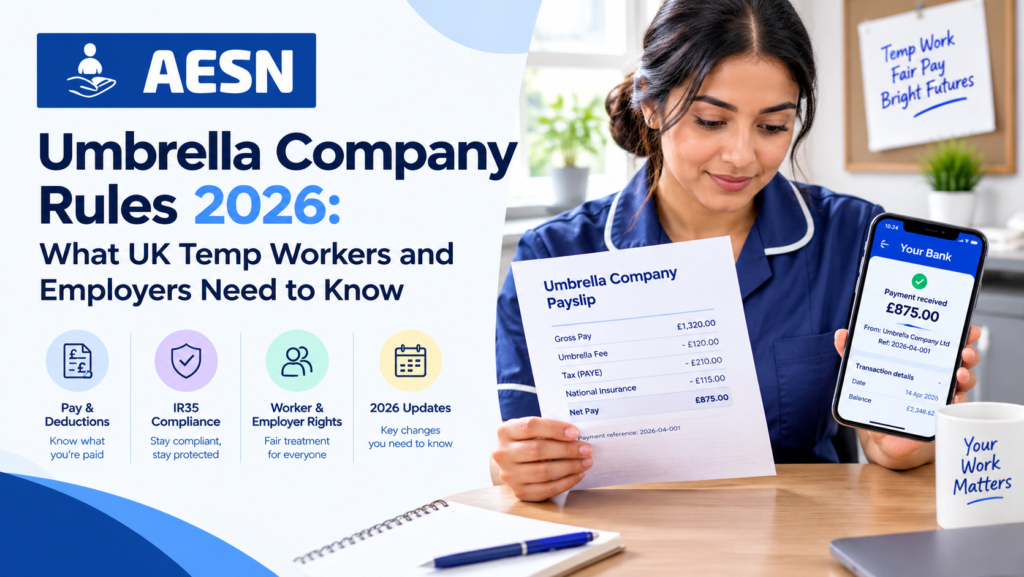
If you are starting a temporary job this winter in a care home, hospital ward, hotel kitchen or restaurant, you may be asked to get paid through an umbrella company. You may have heard that the umbrella company rules changed in 2026. They did, and more changes are expected in 2027. This guide explains in plain English what an umbrella company is, what changed on 6 April 2026, how to read an umbrella payslip and which warning signs to look out for. It also covers what care and hospitality employers who use agency staff should check now. What is an umbrella company? An umbrella company is a business that employs temporary workers and pays their wages through PAYE. GOV.UK describes it as “a business often used by recruitment agencies to pay temporary workers”. The umbrella company does not find you work. The recruitment agency does that. The umbrella company becomes your employer for pay purposes. It runs your payroll, deducts tax and National Insurance, and pays you. Government estimates suggest around 700,000 people work through roughly 500 umbrella companies in the UK. How do umbrella companies work? A typical umbrella supply chain has four parties: The client (hirer): the care home, NHS trust, hotel or restaurant where you do the work. The recruitment agency: finds you the assignment, collects timesheets and invoices the client. The umbrella company: employs you, receives money from the agency and runs your payroll. You, the worker: you do the shifts, submit timesheets and receive your pay. The money moves in this order. You submit your timesheet, the agency invoices the client, and the agency pays the umbrella company an agreed rate for your hours. The umbrella company then makes its deductions and pays you. One point catches many people out. The rate quoted for an umbrella assignment is often not your gross pay. It usually has to cover the umbrella company’s costs before your own tax is taken off. What changed on 6 April 2026? From 6 April 2026, new PAYE rules apply to labour supply chains that include an umbrella company. They apply to payments made on or after that date, whenever the contract started. In short, if an umbrella company fails to pay the PAYE income tax and National Insurance due on your wages, HMRC can now recover it from someone else in the chain: The agency that holds the contract with the end client to supply the worker. Where there is more than one agency, this is the one with the direct contract with the client. The end client, where there is no agency in the chain. This is called joint and several liability. Legal commentary on the rules notes there is no “reasonable care” defence. An agency can be liable even if it did not know about the problem and had carried out checks. The rules were designed to tackle non-compliant umbrella companies, including tax avoidance schemes and “mini umbrella company” fraud. The upshot for workers is that agencies and clients now have a strong financial reason to use only compliant umbrella companies. You should see fewer “too good to be true” pay offers as a result. What the April 2026 rules do not change Your umbrella company is still your employer, and you still have employment rights with it. You are still responsible for making sure the right tax is paid. GOV.UK warns that this applies even when you are employed. The rules do not set a cap on umbrella margins or other deductions. What changes are expected in 2027? A second, separate reform is on the way under the Employment Rights Act 2025. The Act widens the legal definition of an “employment business” in the Employment Agencies Act 1973 to include businesses that handle a worker’s pay. That brings umbrella companies into the same regulatory framework as recruitment agencies. The government’s factsheet says this is expected to start in 2027, together with amended Conduct Regulations. Once it is in force, the Fair Work Agency will be able to regulate umbrella companies as it does other parties in the agency supply chain. The Department for Business and Trade consulted from 6 February to 1 May 2026 on how the rules should apply. The consultation covered pay transparency, security for agency workers and giving workers more choice in how they are engaged and paid. At the time of writing (26 October 2026), the government says it is still analysing responses. We will update this guide when the final rules are published. Change Date Who it affects most Status PAYE joint and several liability for umbrella supply chains 6 April 2026 Agencies and end clients In force Umbrella companies brought within employment business regulation Expected 2027 Umbrella companies, agencies, workers Detail pending consultation response Fair Work Agency enforcement over umbrella companies When the 2027 definition starts Umbrella companies Expected Your rights when you are paid through an umbrella company According to GOV.UK, if an umbrella company employs you, you have the same employment rights as other employees. In practice, that means: A written employment contract from the umbrella company. At least the National Minimum Wage or National Living Wage, paid on time and in full. From 1 April 2026 the rates are £12.71 an hour (21 and over), £10.85 (18 to 20) and £8.00 (under 18 and apprentices). A payslip for every payment. Automatic enrolment in a workplace pension if you are eligible. Holiday pay, either rolled up into each payslip or calculated over a 52-week reference period and paid when you take leave. Ask your umbrella company which method it uses. Statutory Sick Pay if you qualify. Day-one SSP rules apply from April 2026, and our Statutory Sick Pay 2026 guide explains them. The Key Information Document Before you start, the agency must give you a Key Information Document. Under GOV.UK guidance it should show: which umbrella company the agency uses for the work the minimum assignment rate paid to the umbrella company what the umbrella company will deduct your
Bereavement Leave in the UK: What Staff Get Now and the New Day-One Right Coming in April 2027
Losing someone close is hard enough without worrying whether you can take time off work. Yet until now, most UK workers have had no clear legal right to bereavement leave unless the person who died was their child. That is about to change. On 22 September 2026 the government confirmed that, from April 2027, employees in Great Britain will have a day-one right to up to two weeks’ bereavement leave when a close family member dies, and the same right after a pregnancy loss before 24 weeks. For care homes, home care providers, restaurants and hotels, where rotas are tight and staff work across shifts, this is a change worth planning for now. This guide explains what bereavement leave staff are entitled to today, exactly what changes in April 2027, and a practical checklist for care and hospitality employers. This article is general information, not legal advice. Check the latest GOV.UK and ACAS guidance, or take advice, for your own situation. Is bereavement leave a legal right in the UK right now? In most cases, not as a dedicated right. Today the law gives employees three routes: Time off for dependants. Employees have a legal right to a “reasonable” amount of time off to deal with an emergency involving a dependant, including when a dependant dies, to arrange or attend the funeral. The law does not set a number of days, and the time off is unpaid unless the employer chooses to pay. Parental bereavement leave (“Jack’s Law”). Employees whose child dies under the age of 18, or who have a stillbirth after 24 weeks of pregnancy, can take two weeks’ leave from their first day of employment. Employer discretion. Anything beyond that, such as time off after the death of a sibling, grandparent or friend, is “compassionate leave” offered under the employer’s own policy or contract. ACAS is clear that there is currently no legal right to paid time off for bereavement, other than parental bereavement pay. Many employers pay some leave anyway, and staff may also choose to use paid holiday. Current entitlements at a glance Situation Leave right today Paid? Death of a dependant (e.g. spouse, partner, parent, child, someone who relied on the employee) “Reasonable” time off for dependants, from day one No legal right to pay Death of a child under 18, or stillbirth after 24 weeks Parental bereavement leave: 2 weeks, from day one Statutory Parental Bereavement Pay if eligible: £194.32 a week or 90% of average weekly earnings, whichever is lower Death of a sibling, grandparent, friend or other relative No statutory right; employer discretion Only if the employer’s policy says so Pregnancy loss before 24 weeks No dedicated right (sickness absence rules may apply) Sick pay if the person is unwell To get Statutory Parental Bereavement Pay, an employee must have at least 26 weeks’ continuous employment, still be employed on the day of the death, and earn on average at least £129 a week. The leave itself needs no minimum length of service. What changes in April 2027? The Employment Rights Act 2025 creates a new statutory right to bereavement leave. The government’s response to its consultation, published on 22 September 2026, set out how it will work. The detail will be made in secondary legislation, with the new rights coming into force in April 2027. The new right to bereavement leave: key facts Who: employees, from their first day in the job. When: the death of a “loved one” (see the list below), or a pregnancy loss before 24 weeks. How much: up to two weeks, pro-rated to the employee’s usual working pattern. When it can be taken: within 56 weeks of the death or loss, or of the date the employee found out about it. How: in one block or as separate single days. Notice: in the first eight weeks, before the start of the working day or as soon as reasonably possible afterwards; after eight weeks, one week’s notice. Any form of notice is acceptable. Evidence: employers cannot require evidence such as a death certificate. Pay: unpaid. The government has decided against statutory pay, though employers can choose to pay. Protection: the government says employees will be protected from detriment or dismissal for taking the leave. Who counts as a “loved one”? The government response lists: spouses, civil partners and partners in a committed relationship, whether or not they live together; parents; adult children; siblings; the biological, adopted, step and half versions of these relationships, plus equivalent parental relationships in kinship and foster care. Grandparents, aunts, uncles, cousins and friends are not covered by the statutory right. Employers can choose to include them in their own policy. What about pregnancy loss? The new right also covers pregnancy loss before 24 weeks, including miscarriage, ectopic and molar pregnancy, termination, and loss after an IVF embryo transfer. It applies to the pregnant person and to their spouse, civil partner or partner, the other parent, an intended co-parent, and intended parents in a surrogacy arrangement. GOV.UK notes that around one in five women in the UK is estimated to experience a miscarriage in their lifetime. How pro-rating works in practice “Two weeks” means two of the employee’s normal working weeks: Working pattern Statutory bereavement leave from April 2027 Full-time, Monday to Friday 10 working days 3 shifts a week (e.g. a weekend chef) 6 shifts Monday and Tuesday only 4 days Variable or irregular hours Pro-rated to the average working pattern (await regulations for the exact method) The Monday–Friday and Monday–Tuesday rows follow the examples in the government response. The calculation method for irregular-hours staff, common in both care and hospitality, has not yet been published. Why this matters for care and hospitality employers Care and hospitality have some features that make bereavement leave harder to manage than in an office: Minimum staffing levels. A care home cannot run a shift below safe staffing, and a kitchen cannot open without a chef. A day-one, no-advance-notice right means you may find
Staff Retention in Social Care 2026: What the New Skills for Care Report Means for Your Turnover
Care vacancies in England are at their lowest level in a decade. That sounds like good news, and partly it is. But Skills for Care’s annual workforce report, published on 14 October 2026, also shows the workforce is growing more slowly, fewer British people are joining, and international recruitment has fallen sharply. For care providers, the message is clear: staff retention in social care is now the main way to keep rotas covered. You can no longer rely on a steady supply of new starters to replace the people who leave. This guide sets out what the 2026 figures say about care worker turnover, why staff leave, and a practical retention plan you can start this month. Care workforce 2026: the key numbers Skills for Care’s State of the adult social care sector and workforce in England 2026 covers the year to March 2026. Its headline figures, alongside its June 2026 Size and structure report, are below. Measure (England, 2025/26) Figure Vacancy rate 6.2% — lowest since 2015/16 Vacant posts on any given day 96,000 (down 11,500, or 10.5%) Filled posts 1.59 million (up 22,000, or 1.4%) Turnover, care workers and support workers 26.9% (about 221,000 leavers in 12 months) Starter rate, care workers and support workers 31.0% Staff on zero-hours contracts 21% (around 325,000 filled posts) New international recruits from abroad 30,000 — lowest in four years Filled posts held by British nationals Down 40,000 on the previous year Extra posts needed by 2040 410,000 Two things stand out. First, workforce growth of 1.4% is the slowest in four years. Second, more than one in four care and support workers left their role during the year. Vacancies are lower, but churn is still high, and every leaver costs you time, money and continuity of care. Why care worker turnover matters more in 2026 The overseas pipeline has closed The government closed the social care worker visa route to new overseas recruits from 22 July 2025. Transitional arrangements apply to care workers already in the UK. Skills for Care’s chief executive, Professor Oonagh Smyth, has warned that “domestic workforce numbers are falling and there is no dedicated visa route for international recruitment”. In practice, every experienced carer who leaves is harder to replace than it was two years ago. Demand keeps rising Skills for Care projects the sector will need a further 410,000 posts by 2040 as the population ages. Providers who build a stable team now will be better placed as demand grows. Turnover is expensive Each leaver means recruitment advertising, DBS and right to work checks, induction, Care Certificate training, shadow shifts and, often, agency cover while you recruit. It also affects the people you support, who value familiar faces. Why care workers leave The 2026 report and press coverage of it point to a few consistent drivers. Insecure hours. Around 21% of the adult social care workforce is on zero-hours contracts, compared with 4% of the economically active population. Among care workers, the figure is 29%, and it is 34% in domiciliary care. Skills for Care’s analysis shows care workers on zero-hours contracts are more likely to leave. Pay close to the minimum. The National Living Wage rose to £12.71 an hour for workers aged 21 and over from 1 April 2026. Many care roles are paid close to this, so a small hourly difference elsewhere — including in retail or hospitality — can pull staff away. Little progression. Experienced care workers often earn only slightly more than new starters, which weakens the reason to stay. Early-career exits. Staff aged under 25 had the highest turnover of any age group, at 35.5%, according to coverage of the report. Under-25s also make up a smaller share of the care workforce than of the wider working population. Leadership. Turnover falls as registered manager experience increases. Good managers keep good staff. What the data says actually reduces turnover The most useful finding for employers is what happens when good practices are combined. According to reporting on the 2026 report, care worker turnover roughly halved, from 34.3% to 15.3%, where employers combined five factors: Competitive pay Guaranteed hours (not a zero-hours contract) Training Relevant qualifications Full-time employment opportunities The report also found care worker turnover falls from 28.3% to 20.6% as registered manager experience increases. No single change fixes retention. The biggest gains come from stacking several improvements together. A 10-step staff retention plan for care providers Use this plan to turn the findings into action. Most steps cost management time rather than large budgets. 1. Measure your own turnover Calculate turnover for the last 12 months: leavers divided by average headcount. Compare it with the national 26.9% for care and support workers. Break it down by role, length of service, contract type and age. 2. Find out when people leave If many leavers go within their first three to six months, your problem is onboarding, not pay. Track leavers by length of service. 3. Offer guaranteed hours where you can Give staff the option of a contract with set minimum hours. Some people prefer flexibility, so ask rather than impose. Note that the Employment Rights Act 2025 includes planned reforms to zero-hours contracts; check GOV.UK for confirmed commencement dates before changing contracts. 4. Review pay against your local market Benchmark against local care providers and nearby employers in retail, hospitality and the NHS. Small, visible increases for experience and qualifications can matter as much as the headline rate. 5. Build a clear progression path Set out how a care worker can move to senior carer, team leader or deputy manager. Link each step to a qualification and a pay rise. 6. Invest in training and qualifications Support staff through the Care Certificate and a relevant qualification. Training is one of the five factors linked to lower turnover, and it shows staff you are investing in them. 7. Strengthen induction and buddying Pair every new starter with an experienced colleague for their first shifts. Check in at weeks one, four
How to Recruit Care Workers in 2026: A UK Employer’s Guide After the Overseas Visa Route Closed
If you run a care home, a home care service or a supported living provider, you already know that finding good staff is the hardest part of the job. In 2026 it has changed again. Overseas recruitment of care workers closed in July 2025, international arrivals into the sector have fallen sharply, and the number of British nationals working in adult social care is also going down. The good news is that vacancies have eased, and more candidates are looking for work than a year ago. Providers who recruit care workers well, onboard them quickly and keep them, are filling rotas. This guide explains what has changed, where to find care staff in the UK now, and a step-by-step process you can use before winter. The short answer: how do you recruit care workers in 2026? To recruit care workers in 2026, most providers in England now need to hire from the UK labour market. In practice that means: Widening your talent pool to career changers, returners, students and people from retail and hospitality. Recruiting for values and training for skills. Making the offer competitive on pay, hours and travel, not just the hourly rate. Running compliance checks (right to work, enhanced DBS, references) quickly and properly. Using temporary or contract-to-hire staff to cover gaps while you build a permanent team. Focusing hard on retention, especially in the first 90 days. What has changed for care worker recruitment? The care worker visa route closed to overseas applicants From 22 July 2025, the Immigration Rules closed entry clearance (applications from outside the UK) for Skilled Workers sponsored as care workers and home carers (occupation code 6135) and senior care workers (code 6136). According to the Home Office explanatory memorandum to the rule change (HC 997): People already in the UK on another visa can still switch into these roles during a transition period until 22 July 2028. To switch, a worker must have been legally working for the provider sponsoring them for at least three months before the certificate of sponsorship is assigned. Workers already on the Skilled Worker route in these roles are exempt from the closure. The Government has said the transitional arrangement will be kept under review. In England, sponsored care workers and senior care workers must also work for an employer registered with the Care Quality Commission (CQC). If you are thinking about sponsorship, take specialist immigration advice before assigning any certificate of sponsorship. International recruitment has dropped, and so has the British workforce Skills for Care’s 2026 report on the size and structure of the adult social care workforce in England (covering 2025/26) shows how fast things have moved: Measure (England, adult social care) 2024/25 2025/26 Vacancy rate 7.0% 6.2% Vacancies on an average day about 107,500 about 96,000 International recruits into direct care roles (independent sector) about 50,000 about 30,000 Staff turnover rate (independent sector) 24.7% 23.6% Source: Skills for Care, The size and structure of the adult social care sector and workforce in England, 2026. The 2024/25 vacancy figure is derived from the reported fall of 11,500. Two other figures matter for employers: Only around 1,500 of those 30,000 international recruits came through the Health and Care Worker visa. Filled posts held by British nationals fell by 40,000 (3.6%) in 2025/26, and by 130,000 since 2020/21. Looking ahead, Skills for Care estimates that around 410,000 extra posts could be needed by 2040 to keep pace with the growing population aged 65 and over. The jobs market is loosening, but care demand is still rising The KPMG and REC UK Report on Jobs published on 10 October 2026 found that candidate availability kept rising sharply in September, although at the slowest pace in three years. Overall vacancies fell, but Nursing/Medical/Care was one of only three sectors to record growth in demand for temporary staff. Hotel and catering saw some of the sharpest falls in vacancies. For care employers, that combination is an opportunity. More people are looking for work, including people leaving hospitality and retail, while demand for care staff keeps growing. Where to find care workers in the UK now With overseas hiring mostly closed, the providers doing best are fishing in more ponds. Good sources include: Career changers from hospitality and retail. Customer service, shift work and working under pressure transfer well to care. Returners. Former carers, parents returning to work and people who left the sector during the pandemic. Students and graduates. Nursing, health, psychology and social work students often want flexible, relevant shifts. People already in the UK with the right to work. This includes dependants and others whose visa conditions allow the work. Always check, never assume. Local community networks. Colleges, Jobcentre Plus, community groups and staff referral schemes. A specialist healthcare recruitment agency. An agency with an existing pool of vetted candidates can fill temporary shifts quickly and shortlist permanent hires. Recruit for values, train for skills Many great care workers have never worked in care. Skills for Care has long promoted values-based recruitment: hiring people whose values, such as compassion, respect and reliability, match your service, and then training the practical skills. New starters in CQC-regulated services are expected to complete a structured induction covering the Care Certificate standards. Ask scenario questions at interview rather than only checking experience. For example: “A resident refuses their lunch and becomes upset. What would you do?” A step-by-step process to recruit care workers Use this process to cut time-to-hire without cutting corners. Define the role properly. Domiciliary or residential? Days, nights or waking nights? Driver required? Clear job descriptions reduce early leavers. Set a competitive offer. The National Living Wage is £12.71 an hour for workers aged 21 and over from April 2026, so a rate close to the legal minimum will struggle to compete. Compare total package: guaranteed hours, paid travel time and mileage for home care, shift patterns, training and progression. Write an honest, mobile-friendly advert. Lead with pay, location, hours and what support new starters get. Most
Statutory Sick Pay 2026: The Day-One Rules for Care, Hospitality and Agency Workers
Statutory sick pay (SSP) changed on 6 April 2026. It is now paid from the first day of sickness, and there is no longer a minimum earnings threshold. For care homes, home care providers, restaurants, hotels and the agency workers who keep them staffed, this is the first autumn and winter under the new rules. That matters because winter is when short absences peak. Coughs, colds, flu and stomach bugs hit hardest in shift-based, people-facing jobs. This guide explains how statutory sick pay works in 2026, how much it is, who qualifies, and what employers and workers in care and hospitality should do now. This article is general information, not legal or payroll advice. Check GOV.UK or ACAS guidance, or take professional advice, for your situation. What changed with statutory sick pay in April 2026? The Employment Rights Act 2025 made two big changes to SSP in Great Britain. Both came into force on 6 April 2026 under the Employment Rights Act 2025 (Commencement No. 3 and Transitional Provisions) Regulations 2026. No more waiting days. SSP used to start on the fourth qualifying day of sickness. The three unpaid “waiting days” have gone. SSP is now payable from the first day of sickness absence. No lower earnings limit. Before April 2026, employees had to earn at least £125 a week (the 2025/26 lower earnings limit) to qualify. That threshold has been removed, so lower-paid and part-time staff are now covered. To keep costs in check, a new earnings-linked rate applies. SSP is the lower of the flat weekly rate or 80% of the employee’s average weekly earnings. The government estimated that up to 1.3 million low-paid employees would become eligible. It put the extra cost to employers at around £450 million a year, or about £15 more per employee. Before and after at a glance Before 6 April 2026 From 6 April 2026 When SSP starts 4th qualifying day 1st day of sickness Earnings threshold Had to earn at least £125 a week None Weekly amount Flat rate Lower of £123.25 or 80% of average weekly earnings Maximum duration 28 weeks 28 weeks How much is statutory sick pay in 2026? For the 2026/27 tax year, statutory sick pay is £123.25 a week, or 80% of average weekly earnings if that is lower. It is paid for up to 28 weeks. Average weekly earnings are normally worked out over the 8 weeks before the absence. Someone who started recently and has not yet had 8 weeks’ pay still qualifies; their employer works out the amount from what they have been paid. SSP is paid only for qualifying days: the days the person would normally be required to work. To get a daily amount, divide the weekly SSP figure by the number of qualifying days in that week. Worked examples These simplified examples assume steady earnings over the previous 8 weeks. Worker Average weekly earnings 80% of earnings Weekly SSP Part-time kitchen porter £100 £80.00 £80.00 (80% is lower) Part-time support worker £140 £112.00 £112.00 (80% is lower) Full-time healthcare assistant £450 £360.00 £123.25 (flat rate is lower) The 80% rule mostly affects people earning less than about £154 a week. Above that, 80% of earnings is more than the flat rate, so the £123.25 cap applies. Employers can pay more through a company (occupational) sick pay scheme. They cannot pay less than SSP. Tax and National Insurance are deducted from SSP in the usual way. Who qualifies for statutory sick pay? To get SSP, a person must: be classed as an employee for SSP purposes (paid through PAYE) have done some work for the employer be sick for at least one full working day tell their employer they are sick, within the employer’s deadline or within 7 days if none is set Some people are excluded. Examples include anyone who has already had the maximum 28 weeks, someone receiving Statutory Maternity Pay, and people who were in custody or on strike on the first day of sickness. GOV.UK lists the full set of exceptions. Do agency workers get statutory sick pay? Yes. ACAS confirms that agency workers paid through PAYE can get SSP. Since April 2026 that is from day one of sickness, with no earnings threshold. In practice, SSP is usually paid by whoever employs the worker for PAYE purposes. For most agency workers that is the agency (or the umbrella company running their payroll), not the care home or restaurant where they are placed. Check your agreement if you are unsure. There is one grey area. Legal commentary points out that workers on assignment-to-assignment arrangements may have no contract between assignments, so there may be no SSP for those gaps. If an assignment has been agreed and booked but not started, entitlement is less clear-cut. Take advice on specific cases. Do zero-hours and part-time workers get sick pay? Often, yes. Removing the lower earnings limit means low hours no longer rule someone out. A zero-hours or casual worker who is an employee for SSP purposes and is off sick from shifts they were due to work can qualify. Where there is no regular work pattern, ACAS advises employers to agree with the worker which days count as qualifying days. Rotas published in advance make this much easier to evidence. What if I have more than one job? You may get SSP from each employer. This is common in care and hospitality, where people combine a care contract with agency shifts or bar work. Why this matters for care and hospitality this winter Short-term sickness is the biggest driver of absence. The ONS reported a UK sickness absence rate of 2.0% in 2025, about 148.8 million working days lost, or 4.4 days per worker. Minor illnesses such as coughs, colds and flu were the most common reason, at 30.4% of absences. Two findings matter most for these sectors: Part-time workers had a higher absence rate (2.8%) than full-time workers (1.9%). Care and hospitality rely heavily on part-time
How to Become a Care Worker in the UK in 2026: A Step-by-Step Guide
If you want work that matters, steady hours and a career you can grow, care is one of the most open doors in the UK jobs market right now. You do not need a degree. In most roles you do not even need experience. What you do need is the right attitude, the right checks and a clear idea of how to get started. This guide explains how to become a care worker in 2026: what the job involves, the checks and training you will need, what you can expect to earn, and how a recruitment agency can help you land your first shift. Why 2026 is a good time to become a care worker The care sector is hiring, and it is hiring people who are already in the UK. It is a huge workforce. Skills for Care estimates there were around 1.59 million filled posts in adult social care in England in 2025/26. Jobs are still going unfilled. The same report puts vacancies at around 96,000, a vacancy rate of 6.2%. That is the lowest since 2015/16, but still well above many other sectors. Home care needs people most. Vacancy rates were about 9.1% in domiciliary (home) care, compared with under 4% in care homes. Demand will keep growing. Skills for Care projects the sector will need around 410,000 more posts by 2040 as the population ages. Employers are recruiting locally. The Care Worker visa route closed to new applicants from overseas on 22 July 2025, so providers now rely more on people already living in the UK. Pay negotiations are coming. In July 2026 the government confirmed an Adult Social Care Negotiating Body will be set up by the end of 2026, with the first Fair Pay Agreement expected by April 2028. In short: if you are looking for work and you care about people, providers want to hear from you. What does a care worker do? Care workers help people live as safely and independently as possible. Your clients might be older people, people with dementia, adults with learning disabilities or physical disabilities, or people recovering from illness. A typical day might include: helping with washing, dressing, eating and using the toilet (personal care) prompting or supporting with medication, once you are trained preparing meals and drinks helping people move safely, using approved techniques and equipment noticing changes in health or mood and reporting them writing clear, accurate care notes spending time with people: conversation, activities and companionship Care worker, support worker or healthcare assistant? Job titles overlap, which can be confusing when you search for work. Job title Where you usually work Typical focus Care worker / care assistant Care homes, people’s own homes (domiciliary care) Personal care and daily living support Support worker Supported living, community services, learning disability and mental health services Independence, routines, activities and life skills Healthcare assistant (HCA) / healthcare support worker Hospitals, nursing homes, clinics Supporting nurses with clinical and personal care, such as observations The core skills are the same, so experience in one role helps you move into the others. Do you need qualifications to become a care worker? No. Most entry-level care worker jobs do not ask for formal qualifications or previous experience. Employers look for: kindness, patience and respect for people’s dignity reliability and good timekeeping clear spoken and written English, so you can follow care plans and write notes willingness to learn and follow procedures being comfortable with personal care tasks Some roles need more. Home care jobs often ask for a full UK driving licence and access to a car. Nursing home and hospital HCA roles may prefer some care experience. How to become a care worker: 7 steps 1. Check you have the right to work in the UK Every employer or agency must check your right to work before you start. Have your documents ready, such as a passport or, if you have one, a share code from the GOV.UK online service. 2. Get your documents together You will usually need proof of identity, proof of address (for example a recent bank statement or utility bill), your National Insurance number and details of two referees. Gathering these early can speed up your start date by days. 3. Prepare for an enhanced DBS check Personal care for adults is “regulated activity” under the Safeguarding Vulnerable Groups Act 2006. That means care workers normally need an enhanced DBS check with an adults’ barred list check. Your employer or agency applies for it; you provide your details and ID. The Disclosure and Barring Service refreshed its eligibility guidance on 1 September 2026, so employers are checking roles against the new documents. If you are already on the DBS Update Service, tell your recruiter, as it can make rechecks quicker. 4. Write a care-focused CV You probably have more relevant experience than you think. Include: looking after a relative, child or friend customer-facing jobs in hospitality or retail (patience, communication, working under pressure) volunteering any training, such as first aid or food hygiene Keep it to two pages and lead with a short profile saying why you want to work in care. 5. Apply and prepare for interview Care interviews are often value-based. You may be asked how you would protect someone’s dignity, what you would do if a client refused care, or how you would handle a safeguarding concern. Use real examples: “When my grandmother needed help, I…”. 6. Complete your induction and the Care Certificate standards New starters in England are inducted against the 16 Care Certificate Standards. These cover topics such as duty of care, safeguarding, communication, privacy and dignity, infection prevention and health and safety. Expect mandatory training in moving and handling, basic life support and, later, medication. 7. Start work and keep learning Your first weeks usually include shadow shifts alongside experienced colleagues. After that, ask about qualifications. The next section explains the options. Training and qualifications that move your career forward Level 2 Adult Social Care Certificate The
Employment Rights Act October 2026: What Care and Hospitality Employers Must Do Now
October 2026 is the busiest month yet for the Employment Rights Act 2025. One change took effect on 1 October. Several more arrive on 30 October. And the biggest change of all, six-month unfair dismissal rights, follows on 1 January 2027. For most office-based businesses, these changes mean updating a policy or two. For care homes, home care providers, hotels, restaurants and event venues, they go further. Your staff spend every shift with residents, patients, families, guests and customers. From 30 October 2026, how you protect them from those people becomes a legal duty, not just good practice. This guide explains what the Employment Rights Act October 2026 changes are, what they mean for frontline employers, and the practical steps to take in the next four weeks. This article is general information, not legal advice. For decisions about specific cases, speak to an employment solicitor or contact Acas. The Employment Rights Act October 2026 changes at a glance Date Change Who it affects most 1 October 2026 Employment tribunal time limits rise from three months to six months for most claims Every employer 30 October 2026 Duty to take “all reasonable steps” to prevent sexual harassment Every employer 30 October 2026 Employers liable if they fail to protect staff from harassment by third parties such as customers and service users Care, healthcare, hospitality, retail 30 October 2026 Duty to tell workers about their right to join a trade union, plus new union access rights Every employer 1 January 2027 Unfair dismissal qualifying period falls from two years to six months; fire-and-rehire protections begin Every employer, especially high-turnover sectors The rest of this guide takes each change in turn. 1. Tribunal time limits have doubled to six months (live from 1 October 2026) Until now, most employment tribunal claims had to be started within three months less one day of the act being complained about. From 1 October 2026, that window is six months for most claims, including unfair dismissal, discrimination and unlawful deductions from wages. The change was brought in by The Employment Rights Act 2025 (Commencement No. 5 and Transitional Provisions) (Amendment) Regulations 2026. Which cases does it apply to? The new limit applies where the relevant date, usually the date of dismissal or the act complained of, falls on or after 1 October 2026. Ongoing conduct can be harder to date, so an earlier incident may still be caught if it forms part of a continuing pattern. Why it matters more than it sounds Acas early conciliation pauses the clock. That pause was extended to 12 weeks in December 2025. Add a six-month limit, and a former employee could bring a claim close to 10 months after leaving. For care and hospitality employers, where staff turnover is high and managers move on quickly, that creates a real evidence problem. By the time a claim lands, the manager who made the decision may have left, and rotas, messages and CCTV may be gone. What to do now Extend how long you keep disciplinary, grievance and dismissal records Write down the reasons for decisions at the time, not later Collect witness contact details before staff leave Review CCTV and messaging retention so footage is not wiped too early Make sure exit processes capture any complaints raised on the way out 2. Sexual harassment: from “reasonable steps” to “all reasonable steps” (from 30 October 2026) Since October 2024, the Worker Protection Act 2023 has required employers to take reasonable steps to prevent sexual harassment. From 30 October 2026, the Employment Rights Act raises the bar: employers must take all the steps that are reasonable for their organisation to prevent sexual harassment, according to GOV.UK’s business guidance. The word “all” matters. Doing some sensible things will no longer be enough if there were other reasonable steps you could have taken and did not. The government also has powers to set out specific steps employers must take in future regulations. What “all reasonable steps” looks like in practice What is reasonable depends on your size, sector and type of work. Acas points to measures such as: A written harassment policy that staff actually know about A risk assessment of where and when harassment is likely Training for staff and managers Clear, safe ways to report concerns, including anonymously Monitoring and recording incidents so patterns are spotted Updating contracts and terms with third parties Physical measures such as alarms or cameras where appropriate A care provider with lone workers visiting homes at night will need different steps from a small café. The test is whether you have done everything reasonable for your setting. 3. Third-party harassment: the change frontline employers cannot ignore (from 30 October 2026) This is the most significant October change for AESN’s core sectors. From 30 October 2026, employers must not permit the harassment of their employees by third parties, such as customers and clients. The protection covers harassment related to protected characteristics under the Equality Act 2010, apart from pregnancy and maternity and marriage and civil partnership. It applies in England, Wales and Scotland, not Northern Ireland. Acas defines a third party as “anyone a worker is in contact with through work” who does not work for you. That includes customers, clients, service users, contractors, event attendees and members of the public, online or in person. What this means in care and healthcare Care workers and healthcare assistants regularly face verbal abuse, racist comments or unwanted sexual behaviour from service users or their relatives. Some of this is linked to dementia or other conditions, which makes it complex. The new law does not change your duty of care to residents. It does mean you must take all reasonable steps to protect staff too. Practical examples: Recording known risks in care plans and sharing them with every worker, including agency staff, before a shift Pairing staff or changing allocations where a resident has a pattern of harassing behaviour Setting clear expectations with families and visitors, for example in visiting policies
Right to Work Checks in 2026: An Employer’s Guide to the New Rules
A right to work check is the legal check a UK employer must complete before someone starts work, to confirm they’re allowed to do that work. Done correctly, it gives you a “statutory excuse” against a civil penalty if the person later turns out to be working illegally. From 1 October 2026, the rules also cover many workers, individual subcontractors and online platforms, not just employees. This guide explains what changed, the three legal ways to do a right to work check, how share codes work, what to do about follow-up checks, and how to stay compliant when you use agency or contract labour. What is a right to work check? A right to work check confirms that someone has permission to work in the UK and to do the specific work you’re offering. The legal basis is the Immigration, Asylum and Nationality Act 2006. The detailed method is set out in the Home Office’s Employer’s guide to right to work checks. Three rules shape every check: Check everyone, including British and Irish citizens, the same way. Check before work starts. A check done after the first shift doesn’t give you a statutory excuse for the time already worked. Follow the prescribed method exactly. A check that cuts corners may not protect you. What changed on 1 October 2026? Section 48 of the Border Security, Asylum and Immigration Act 2025 widens who counts as an “employer” for right to work purposes. Under the Home Office’s updated guide, in force from 1 October 2026, the scheme now applies where a business engages people under: a worker’s contract, for example casual, zero-hours or temporary workers who aren’t employees an individual sub-contractor arrangement an online matching service, meaning platforms that match service providers with customers for payment The government has highlighted sectors such as construction, food delivery, beauty salons and courier services, but the rules aren’t limited to those sectors. Who it applies to: the new civil penalty liability covers these arrangements where the work sectors such as logistics, facilities management and hospitality started on or after 1 October 2026. Even so, it’s sensible to review existing contractors and casual workers now, so you aren’t caught out when engagements are renewed or restructured. Does this change anything for agency workers? Under the Home Office guide, when a worker is supplied by an employment business (a recruitment agency that supplies temporary workers), that business counts as the worker’s employer for right to work purposes. It’s therefore responsible for the check. If your labour comes through longer chains, such as an agency plus an umbrella company or a contractor plus subcontractors, agree in writing who carries out each check and ask for evidence that it’s been done. Don’t assume someone else has done it. The three ways to do a right to work check Method Who it’s for What you need What to keep Manual document check Anyone with acceptable original documents from the Home Office’s List A or List B. Commonly British and Irish citizens with a passport, or a birth certificate plus proof of National Insurance number The original documents, checked with the holder present, in person or by live video call while you hold the originals A clear copy of each document and the date of the check Home Office online check (share code) People with an eVisa or other digital immigration status, which includes most non-British and non-Irish workers The person’s share code and date of birth, entered on GOV.UK’s “Check a job applicant’s right to work” service The profile page (PDF or screenshot) and the date of the check Digital verification service provider (IDVT) British and Irish citizens with a passport (or Irish passport card) A certified provider listed by the Office for Digital Identities and Attributes. Providers charge a fee The provider’s output and the date of the check Key details most guides miss BRPs are no longer accepted. Biometric residence permits stopped being issued on 31 October 2024. People with an eVisa can only prove their right to work through the online service, and a manual check of an expired BRP isn’t acceptable proof. Expired British and Irish passports are accepted in two cases. In a manual check, a British or Irish passport is acceptable whether current or expired. Under the 2026 guidance, digital verification providers can also verify British or Irish passports up to 6 months past expiry. You still have to match the face. Whatever the method, satisfy yourself that the photo matches the person in front of you. Right to work share codes: what employers and workers need to know A right to work share code is a 9-character code beginning with “W”. It’s valid for 90 days and can be used as many times as needed in that period. Workers generate a code through GOV.UK’s “Prove your right to work to an employer” service. British and Irish citizens don’t need one. They prove their right to work with documents or a digital verification provider. Employers enter the code and the person’s date of birth on GOV.UK’s “Check a job applicant’s right to work” service. The result shows what work the person can do and any time limit. Reject codes beginning with “R” or “S”. These are for renting a property or other services, not employment. How to do a right to work check: step by step Choose the method that fits the person’s status (see the table above). Get the evidence: original documents, a share code and date of birth, or a digital verification result. Check it in the person’s presence (in person or by live video). Confirm the photo matches, the dates are valid and the work allowed covers the role. Check restrictions. Students, for example, may have limits on term-time hours. Make sure the role and hours you’re offering fit within any conditions. Keep a clear copy and record the date you did the check. Set a reminder for any follow-up check if their permission is time-limited. Store the records securely for the whole time the person works for you and for two years afterwards, then securely destroy them. Follow-up checks and the Employer Checking Service If someone has time-limited permission, your statutory excuse only lasts until that permission ends. Do