Which skills are important in critical thinking?
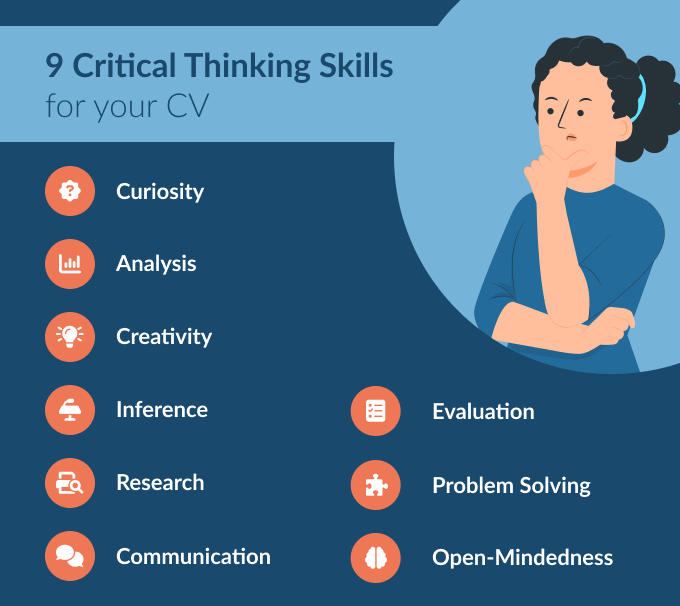
Which skills are important in critical thinking? You can understand and respond to events using all the facts and information at your disposal if you have the ability to think critically. To define an issue and create workable answers, critical thinking at work typically entails digesting and arranging facts, statistics, and other information. Think about the critical thinking skills you already have and those you might want to work on developing so you can emphasize them in interviews and on your CV. Additionally, you can think about making goals and adopting routines to support your development of the critical thinking abilities required for professional success. In this article today, we define critical thinking, discuss its value, and offer tips for honing your critical thinking skills. Also read: How skills affect career choice? Critical thinking: What is it? Analyzing information to fully comprehend an issue or topic is the act of critical thinking. The steps of the critical thinking process often entail gathering facts and data, posing deliberate queries, and examining potential answers. For instance, if you work in human resources and must settle a dispute between two workers, you will utilize critical thinking to determine the nature of the dispute and the appropriate course of action. Also read: How to improve career progression? Why it’s necessary to think critically? Every sector, at every career level, from entry-level workers to top executives, recognizes the value of critical thinking abilities. Problem-solving skills include the ability to operate both independently and collaboratively. Using critical thought can help with problems including management inadequacies, financial problems, and process inefficiencies. Employers value and seek out applicants that have high critical thinking abilities because of this. Also read: 7 Tips to Manage Your LinkedIn Profile Here are five prevalent and significant critical thinking skills you might consider emphasizing in an interview or on your resume: 1. Observation Critical thinking begins with the ability to observe. A new issue can be promptly sensed and recognized by observers. Those who are adept at observing can also discern the potential causes of issues. Based on their prior experiences, they might even be able to anticipate when a problem might arise before it really does. By slowing down how quickly you receive information and by paying more attention to your environment, you can improve your observational skills. To carefully consider what you’re hearing or seeing, you may use mindfulness techniques, journaling, or active listening both inside and outside of the workplace. Then, take into account whether you see any patterns in behavior, transactions, or data that your team could find useful to address. Also go through Is Higher Salary Worth Relocating? – AESN Review Analytical abilities become crucial once an issue has been discovered. Knowing which facts, data, or information are crucial to the analysis and evaluation of a situation is a prerequisite. This frequently entails compiling unbiased research, checking the accuracy of the data with pertinent inquiries, and impartially evaluating the results. By accepting new challenges, you can develop your analytical skills for critical thinking. To challenge yourself to think differently and take new ideas into consideration, you may, for instance, read a book about a subject you don’t understand or enroll in an online math course. By doing this, you can develop the abilities to understand new information and come to informed conclusions. Speculation Drawing inferences from the data you gather entails the skill of inference, which may call for technical or industry-specific training or expertise. Making an inference denotes establishing conclusions based on scant knowledge. For instance, with the information at hand, a mechanic for a car may have to guess what is causing a car’s engine to stall out at seemingly random intervals. Focus on making educated guesses rather than jumping to conclusions to develop your inference skills. This calls for taking your time to thoroughly search for and take into account as many hints as you can, such as pictures, statistics, or reports that could aid in your evaluation of a situation. Go through Before You Quit Your Job, Ask Yourself These Questions – AESN Interaction When it comes to explaining and debating problems and potential solutions with coworkers and other stakeholders, communication skills are crucial. By having challenging conversations, such as when you and another participant may differ on the topic, you can hone your communication skills within the context of critical thinking. For the sake of understanding other people’s viewpoints and being able to articulate your ideas in a cool, collected manner, keep up good communication practices like active listening and respect. You and your colleagues can evaluate solutions more successfully if you do this. Read: 5 Ways to Earn Side Income – AESN Resolving issues Executing your solution comes after you’ve identified and studied the issue at hand and made your decision. To apply the best answer and determine whether the solution is effective in relation to the aim, problem-solving frequently calls for critical thinking. You might want to read Here’s Why Networking Is Important for your Success – AESN By establishing objectives to increase your industry knowledge within your sector, you can improve your problem-solving abilities. If you have a solid grasp of knowledge related to your business, fixing problems at work should become easier. It can be beneficial to watch how those around you resolve issues at work. Take note of their methods and inquire about the steps they took. You might want to read: Which skills are important in the workplace? More capacity for critical thought There are other soft skills that are related to careful analysis, even if the five talents mentioned above are necessary for effective critical thinking. Here are five additional abilities to think about when honing your critical thinking: Metacognitive skills Logical reasoning abilities Innovative thinking abilities Judgment abilities Conceptual thinking abilities Also read: How to excel in an interview You may also be interested in the following articles:- Recruitment Agency in UK Job providing agency in UK Agency that provides job in UK Agencies near me / Uk How to get jobs in
10 Ways To Improve Your Critical Thinking Skills

10 Ways To Improve Your Critical Thinking Skills Critical thinking abilities enable you to comprehend and respond to circumstances using all available facts. Critical thinking at work typically entails organizing and processing facts, statistics, and other information to describe an issue and generate effective solutions. What is critical thinking? Critical thinking is the process of evaluating ideas to fully comprehend a problem or topic. Steps in the critical thinking process usually entail gathering information and analyzing it. Collecting facts and data, asking intelligent questions, and examining viable answers are all part of the critical thinking process. If you work in human resources and need to mediate a problem between two employees, for example, you will utilize critical thinking to determine the nature of the conflict and the appropriate course of action. Why is critical thinking so crucial? Critical thinking entails excellent communication and problem-solving talents, as well as a determination to overcome our natural ego. To put it another way, to think critically, you must let go of the instinctive need to perceive things through your own eyes or through the eyes of the society in which you grew up. Only then will you be able to properly notice challenges, analyze and assess them, and come up with novel perspectives and answers. It’s easy to see where critical thinking comes in handy if we understand its nature. Deep and rational thought is always useful, and it will make you stand out from the crowd, whether you’re sitting in a business school class, studying another subject, or attempting to make meaningful contributions to your profession. So, how do you develop those abilities? Here are ten suggestions to assist you to succeed. 1. Take Time There is no such thing as a Scantron test for critical thinking. You won’t usually be given a prefabricated set of multiple-choice solutions to a problem; instead, you’ll have to come to your conclusions by studying the situation and reaching the best possible conclusion. That takes time, so be patient with yourself and give yourself permission. Read: 8 Steps to Finding the Right Career for You – AESN 2. Be Willing to Experiment Critical thinking isn’t a straight line. It has a lot of rabbit trails and false starts, which is fine. You must investigate each concept in turn, and you will almost certainly reject them. After all, there are many more lies than truths in the world, and a critical thinker’s role is to distinguish between the two. If one way of thinking doesn’t work, try a different one. If one source of evidence is exhausted, look for a second, third, or fourth. The medal for critical thinking belongs to the one who discovers the clearest truth, not the person who finishes first. 3. Accept Risk Critical thinking carries the danger of being incorrect. You may not find an answer to a problem or topic no matter how diligently you search — or even if you do, your answer may not be correct. Those who are terrified of being mistaken, regrettably, tend to think superficially and gloss over the genuine facts to prevent this possibility. This isn’t an appropriate approach to education, job, relationships, or any other part of life. Also read: Why Delegation is important in Leadership? – AESN 4. Embrace Difficulty You must accept adversity if you wish to develop the valuable skill of critical thinking. This ability is respected not because it is easy, but because it requires time, effort, and mental fortitude. There’s nothing wrong with you if you can’t come to a decision straight away. However, if you give up, something is amiss, so embrace your dissatisfaction and keep trying. 5. Ask Questions Critical thinking is all about asking the right questions at the right time or even the wrong questions at the wrong time, as long as they lead to a solution. Be open to asking a lot of questions, not just of others but also of oneself. What are the most important things for you to concentrate on? What information must be unearthed? Where do you think you’d find this information? What would you say to someone who came to the same conclusions as you? Continue to ask these questions, and your critical thinking skills will improve quickly. 6. Use Metacognition The process of thinking about thinking is known as metacognition. It entails examining your views for assumptions, omitting to analyze relevant information, or refusing to admit ideas you don’t agree with. Metacognition can also help us create mental processes that we can utilize again and over again. For example, you might approach a topic by gathering evidence first, then organizing it, searching it for information, assembling the most important data, and then coming to a conclusion. You’re less likely to skip a step or leave something out if you can think about the procedure from beginning to end. 7. Question Assumptions Assumptions should constantly be questioned. You face the risk of adding your self-evident facts and prejudices into your considerations whenever you think something to be true without considering it. Read: 8 Steps to Finding the Right Career for You – AESN 8. Analyze Evidence This is linked to the concept of questioning assumptions. It’s different, though, in that you deliberately seek proof rather than rejecting unhelpful preconceptions, prejudices, and unreasonable ideas. It’s important to note that “evidence” does not refer to a similar point of view; rather, it refers to qualitative or quantitative data acquired as objectively as possible. This can be more difficult at times, such as when applying literary criticism and debating the author’s meaning. However, gathering as much evidence as possible before moving forward is still the best idea. 9. Explore Another POV The ability to see an issue objectively is a key component of critical thinking. Of all, most of us are innately biased and bring our thoughts, beliefs, and experiences to the table, so getting that “view from above”