
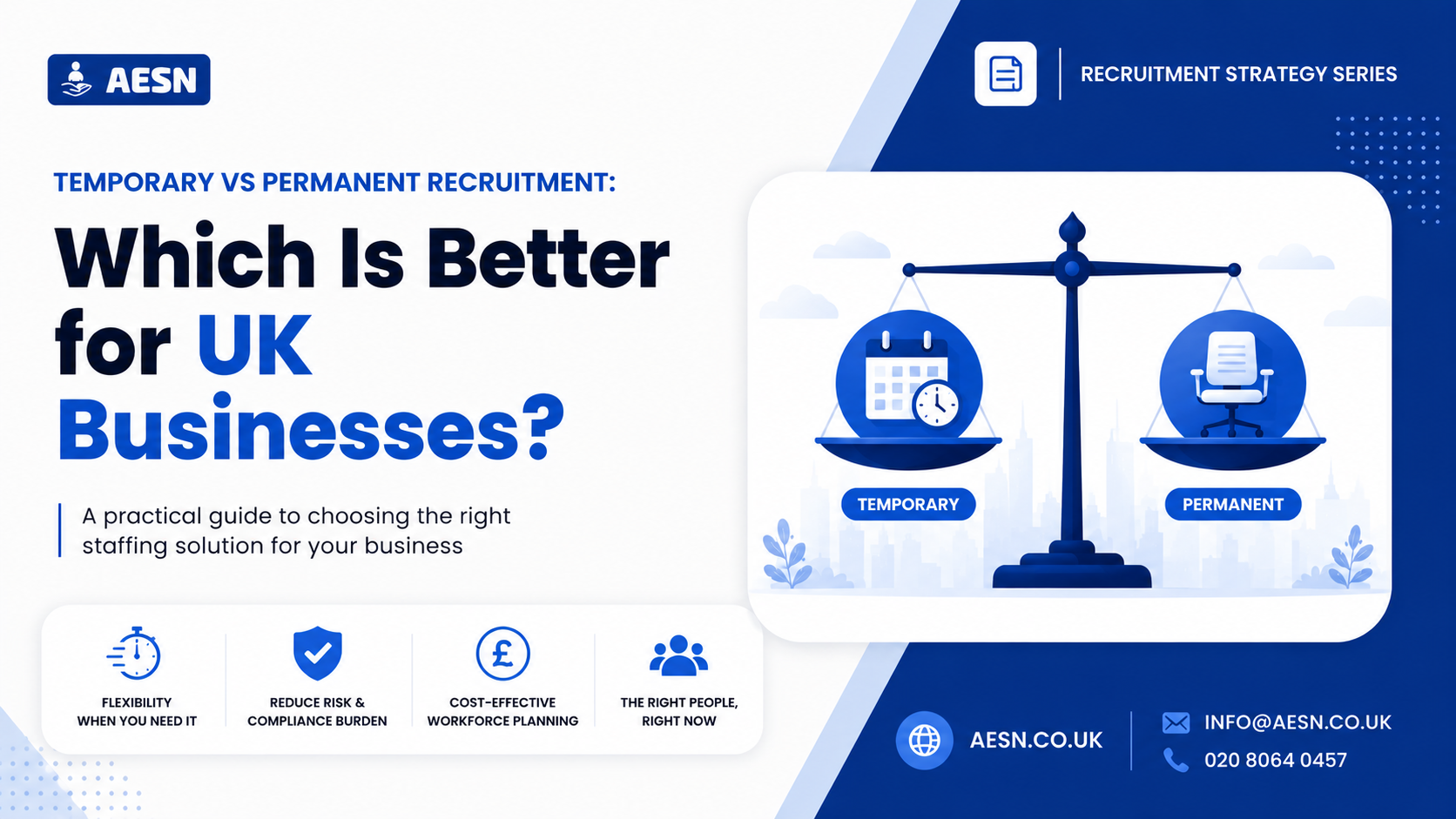
One of the most common questions AESN receives from new and established clients alike is a deceptively simple one: should we hire temporary or permanent staff? The right answer depends on your operational context, your budget cycle, your risk tolerance, and — often — the sector you work in.
This guide breaks down both models in plain terms, explains when each is appropriate, outlines the real cost differences, and helps you decide which approach fits your current need.
Defining the Two Models
Temporary Staffing
Temporary staffing — also called agency staffing, flexible staffing, or bank staffing in healthcare — involves sourcing workers through an agency for a defined period or on an ongoing ad hoc basis. The agency typically employs the worker (making it the employer of record), handles payroll, compliance, and NI contributions, and charges the client an agreed hourly rate that includes its margin.
Temporary arrangements range from a single shift cover to long-term rolling contracts lasting months or years. In sectors like healthcare, education, and hospitality, temporary staffing is not a stopgap — it is a core workforce strategy used by the largest NHS trusts, academy chains, and hotel groups in the country.
Permanent Recruitment
Permanent recruitment involves sourcing candidates who are then employed directly by your organisation on a fixed or indefinite employment contract. The agency’s role ends at the point of placement, and it charges a one-off fee — typically expressed as a percentage of the candidate’s first-year salary, most commonly between 12% and 20% depending on seniority and sector.
The hiring timeline for permanent roles is longer than for temporary placements — typically four to twelve weeks from instruction to start date — and the commitment is greater. If the placement does not work out, most agencies offer a rebate period (usually 8–12 weeks), but the process of replacing a failed hire is costly and disruptive.
When Temporary Staffing Makes More Sense
- Urgent or same-day cover is required — a ward short-staffed, a chef no-show, a security post unmanned
- The volume of need fluctuates seasonally — hotel groups scaling for summer, schools needing cover at the start of term
- You are testing a candidate before committing to a permanent offer (temp-to-perm or contract-to-hire)
- You need specialist skills for a short-term project — a compliance review, a refurbishment period, a system migration
- Budget is uncertain or subject to approval cycles — temporary spend is operational expenditure, not capital
- You are in a regulated sector (healthcare, education, security) where compliance management is complex — outsourcing it to an accredited agency reduces your risk exposure
When Permanent Recruitment Makes More Sense
- You need cultural fit, institutional knowledge, and long-term team stability
- The role requires deep specialist expertise that cannot be delivered by a rotating temporary workforce
- You are building a management layer — department heads, clinical leads, head teachers — where continuity is operationally critical
- The cost of repeated temporary cover over twelve months would exceed a permanent placement fee
- The role carries significant client-facing responsibility where staff continuity is visible and valued
The True Cost Comparison
| Cost Factor | Temporary Staffing | Permanent Placement |
| Upfront cost | Zero — pay per shift used | Placement fee (12–20% of salary) |
| Ongoing cost | Hourly rate inclusive of NI, payroll, compliance | Direct employment costs: salary, NI, pension, holiday pay |
| Management overhead | Low — agency handles payroll and compliance | Standard HR and line management |
| Speed to fill | Hours to 48 hours for urgent needs | 4–12 weeks |
| Risk if it doesn’t work | Low — simply stop booking | Rebate periods vary; replacement costs accrue |
| Long-term cost (12 months) | Higher per hour; lower commitment | Lower total; higher front-loaded risk |
For roles filled consistently over twelve months, permanent placement is almost always more cost-efficient. For variable demand, compliance-heavy roles, or short-term requirements, temporary staffing delivers better value and lower risk.
The Hybrid Approach: What Most Organisations Actually Do
In practice, most sophisticated employers in healthcare, education, and hospitality use a hybrid model. They maintain a permanent core team — carefully recruited for culture, skills, and longevity — and supplement it with temporary agency staff for peak demand, sickness absence, and specialist short-term needs.
This model, sometimes called a ‘blended workforce strategy,’ requires a reliable agency partner who can deliver consistently across both temporary and permanent requirements. AESN provides both services across all of our core sectors, with the same compliance standards applied regardless of contract type.
AESN’s Staffing Solutions
AESN operates across Healthcare, Hospitality, Education, Security, and Aviation. Whether your need is a nurse for tonight or a Head of Service for the next decade, our consultants work as your advisors — not just order-takers. Contact us: info@aesn.co.uk | 020 8064 0457