How to learn writing skills

How to learn writing skills The learning process never stops for authors. There’s always something new we can learn whether it’s new writing skills or a tool. Grammar, spelling, punctuation, sentence structure, and other fundamental writing abilities are things we work to perfect, and we also research our form (fiction, nonfiction, or poetry) and genre (romance, suspense, fantasy, etc.). For instance, in addition to mastering the fundamentals of writing, storytellers must also learn the plot, characterization, setting, dialogue, and other components of stories. Also read: How skills affect career choice? It can seem overpowering at times. It can be challenging to know where to begin and how to maintain learning over the long term because there is so much to learn and so many different ways to learn it. Despite the fact that people are writing for years, they are constantly picking up new writing ideas. How to Improve Your Writing? The following advice provides some methods to learn writing skills with an emphasis on lifelong learning. 1. Read As long as the book you’re reading is well written and especially if you pause to research questions that come up while you’re reading, you will organically learn writing skills through reading (such as looking up a word in the dictionary). Although listening to audiobooks won’t help you learn fundamental writing abilities like grammar, spelling, and punctuation, they are a great way to learn about form and genre. Also read: How to improve career progression? 2. Keep accessible fundamental writing tools When we were younger, carrying a dictionary was impossible. In the past, we were unable to travel with a glossary, thesaurus, set of encyclopedias, and books on the art of writing. But now that smartphones have been developed, all of these tools may fit in a pocket or a purse. Even though people still prefer paperbacks for craft books, having quick and convenient access to a dictionary and thesaurus on a smartphone has been quite helpful. When a question arises, make sure you research it and memorize the answer. 3. Attend a workshop or class Ideally, you can find a course in a recognized university or community college in your neighborhood or online. Classes and courses can also be found in local bookstores, community centers, and libraries. Additionally, there are a lot of online courses available. Ensure that any course you enroll in is being offered by a reputable source. Also read: 7 Tips to Manage Your LinkedIn Profile 4. Books Among your most crucial tools will be books on the subject. We’ve discovered that books on the craft are the most practical, educational, and enlightening study materials, other than reading and taking classes. You can get broad books on writing and creativity as well as books on particular forms, genres, and writing elements (like plot, characterization, etc.). We think you can never have too many of these! 5. Develop the practice of taking notes. Maintaining thorough notes on your queries and the ideas you’re learning while reading a book, a poem, or a style manual will help you retain new knowledge and abilities while also creating a record that you may consult at any time. Also go through Is Higher Salary Worth Relocating? – AESN 6. Interviews Author interviews have given me a great deal of knowledge about all aspects of writing, from the process of coming up with a writing idea to the process of publishing and marketing a writing project. Anyone who is eager to learn from authors can benefit greatly from their practical, hands-on experience. We strongly advise looking for author interviews, especially from your favorite authors, whether you read, watch, or listen. Go through Before You Quit Your Job, Ask Yourself These Questions – AESN 7. Subscribe These days, many subscriptions are free (like Writing Forward!). Search for blogs and podcasts that are frequently updated and accommodate your schedule. To be sure you’re getting reliable information, be sure to examine the source’s legitimacy. So, to learn good writing skills, you must be involved in different channels. Read: 5 Ways to Earn Side Income – AESN 8. Work with a writing tutor You can gain a lot from a writing coach if you’re further along in your writing and getting ready to submit or publish a significant project, like a novel, and it fits within your budget. While attentively leading you to make major improvements to your project and your writing overall, a competent coach will help you keep your creative vision. Read: 5 Ways to Earn Side Income – AESN 9. Learn from editors In a similar vein, an editor may teach you a lot. Once more, this is mainly geared at authors who are close to publication or submission. A developmental editor will examine the text’s content and organization. A developmental editor will examine your project’s content and organization and offer comments on elements like story, character, and pacing. Grammar, spelling, punctuation, and sentence structure will all be reviewed by a copy editor. You’ll immediately identify the errors you commit time and time again in your writing and be able to stop doing them in the future. You might want to read Here’s Why Networking Is Important for your Success – AESN 10. Practice your craft constantly Regardless of what you are learning, practice is crucial. Even if you can only spend a page or a half-hour on your practice each day, try to write anything. Scheduling learning time is an excellent approach to make sure that you’re continually improving your abilities. You don’t have to set aside a lot of time to continue learning how to write. For instance, each episode of the Grammar Girl podcast lasts only five minutes. One podcast can be listened to daily or once a week. You might want to read: Which skills are important in the workplace? You can resolve to read three craft books each year. Every little amount helps, even if you’re just learning, and many writers remember knowledge better when it’s consumed in smaller chunks. Also read: How to excel in an interview
How to develop leadership skills
How to develop leadership skills In most professions and educational settings, leadership abilities are highly valued. It is quite simple to understand why. A good leader is extremely hard to come by; someone who can accomplish a task well. In addition to that, he should also be inspiring and motivating those around them. Many people would rather follow when it is possible rather than assume leadership roles. It is because they just lack interest in doing so. Others aspire to be leaders but are unwilling to put in the effort necessary to practice and reflect on their own performance. This means that if you have a chance to develop leadership skills and a drive to advance your career, you will be an invaluable asset to a company. There are many different ways to lead. You could desire to lead the debating society or the football squad at your school. Or perhaps politics or activism are your interests. Or perhaps you have your heart set on a managerial position when you start working, with the goal of rising to the position of CEO as quickly as possible. This article looks at how you can develop your leadership skills no matter what your goals may be. Also read: How to improve career progression? Provide yourself with practice chances You are not be very interested in extracurricular activities, but you want to hold leadership positions in the future. For this, there are the greatest method to show off your leadership skills and hone them in a setting that is low-risk. In order to develop a leadership skills, you should start being practical. Leaders position in extracurricular activities is frequently quite simple because there aren’t many people who desire to take on leadership roles in the first place. Additionally, it is a setting that is fairly forgiving of mistakes. But it’s in these situations that you’ll learn how to cope with managing individuals who could hold divergent viewpoints and test your ability to persuade them to cooperate so that your team performs better than the sum of its individual parts. Also read: 7 Tips to Manage Your LinkedIn Profile Receive candid criticism The challenge with playing a crucial role in school extracurricular activities is that if you’re doing a decent job, others can be reluctant to criticize you out of concern that they’ll discourage you. It’s terrible because receiving constructive criticism is essential to developing your leadership abilities. You might get 360-degree feedback at work, which entails comments from your manager, your peers, and anyone beneath you in the hierarchy. Although it’s doubtful that your extracurricular activity will involve anything this complex, you can create your own version by asking a few individuals you respect for their input. If it doesn’t work, think about requesting anonymous comments using a tool like a Google form. Or, if a teacher is participating in the activity—for example, a PE instructor working with the school hockey team—you might ask them what they thought of your performance. Wherever you can, try to get feedback that can be put to use. Also read: How skills affect career choice? Improve your ability to follow. Nobody always acts as the leader. You might be the captain of the school chess team. But you have a chorus role in theater club. That means, you may be a leader in one situation but a follower in another. And it is true throughout life; for example, boards of shareholders have authority over CEOs. However, you can improve your leadership abilities even when you are a follower. Learn from those leaders first; what are they doing well or incorrectly? And what would you change? The opportunity to improve as a follower, though, is more significant than these things. Think about what a leader would want a follower to be doing based on your own leadership experience, and then really execute it. Also go through Is Higher Salary Worth Relocating? – AESN Consider your team’s potential. Developing your team to the fullest extent of their abilities is one of the most important responsibilities of a leader. Although it may seem obvious, this is a leadership trait that is easily overlooked in the day-to-day activities. Any leader’s ultimate goal is to have a replacement in place who will make sure that all of their efforts don’t go to waste. That’s crucial in a school setting where you are aware that the role won’t be one you play for very long. So, if you think anyone on your team would be capable of stepping up and taking your place, encourage them to develop their leadership abilities and provide them chances to do so. Go through Before You Quit Your Job, Ask Yourself These Questions – AESN Establish definite, attainable goals As a leader, it is your responsibility to promote everyone else’s growth while maintaining your own. Setting yourself measurable, attainable goals is one technique to gauge your personal improvement in addition to receiving and acting upon feedback. Finding a mechanism to assess your leadership effectiveness independently of the effectiveness of the team as a whole is also a smart idea. What you want to accomplish will determine the type of metric you employ. Whatever metric you choose, make sure your goals are attainable, and ideally choose goals that will let you track your development over time. This is one of the most crucial leadership skills you should develop. Read: 5 Ways to Earn Side Income – AESN Don’t focus too much on personality assessments It may be suggested to you that you employ personality assessments to improve your leadership skills. Many lack scientific rigor or are acceptable in one cultural context but not in another. They will therefore draw erroneous conclusions as a result. Even those that are based on sound science can lead you astray. For instance, it’s usually advisable to trust your own judgment and disregard the quiz. And, if someone tells you that you should use a certain leadership style because you’re an introvert even though another style has been serving
Which skills are important in critical thinking?
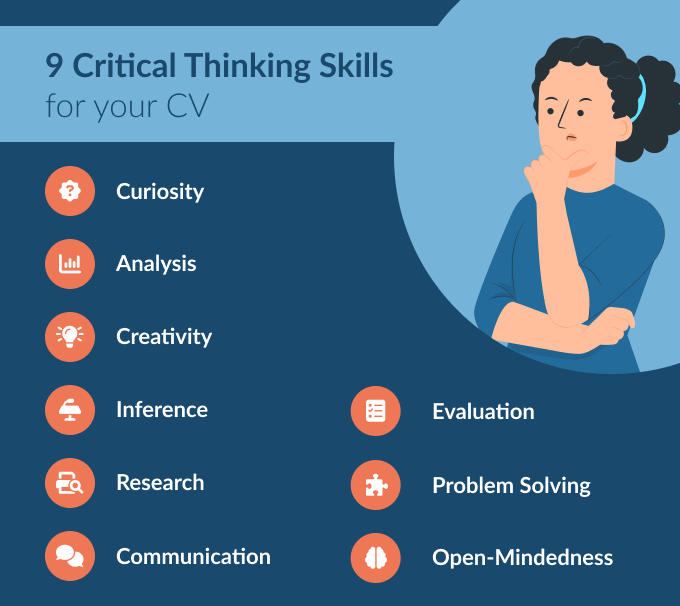
Which skills are important in critical thinking? You can understand and respond to events using all the facts and information at your disposal if you have the ability to think critically. To define an issue and create workable answers, critical thinking at work typically entails digesting and arranging facts, statistics, and other information. Think about the critical thinking skills you already have and those you might want to work on developing so you can emphasize them in interviews and on your CV. Additionally, you can think about making goals and adopting routines to support your development of the critical thinking abilities required for professional success. In this article today, we define critical thinking, discuss its value, and offer tips for honing your critical thinking skills. Also read: How skills affect career choice? Critical thinking: What is it? Analyzing information to fully comprehend an issue or topic is the act of critical thinking. The steps of the critical thinking process often entail gathering facts and data, posing deliberate queries, and examining potential answers. For instance, if you work in human resources and must settle a dispute between two workers, you will utilize critical thinking to determine the nature of the dispute and the appropriate course of action. Also read: How to improve career progression? Why it’s necessary to think critically? Every sector, at every career level, from entry-level workers to top executives, recognizes the value of critical thinking abilities. Problem-solving skills include the ability to operate both independently and collaboratively. Using critical thought can help with problems including management inadequacies, financial problems, and process inefficiencies. Employers value and seek out applicants that have high critical thinking abilities because of this. Also read: 7 Tips to Manage Your LinkedIn Profile Here are five prevalent and significant critical thinking skills you might consider emphasizing in an interview or on your resume: 1. Observation Critical thinking begins with the ability to observe. A new issue can be promptly sensed and recognized by observers. Those who are adept at observing can also discern the potential causes of issues. Based on their prior experiences, they might even be able to anticipate when a problem might arise before it really does. By slowing down how quickly you receive information and by paying more attention to your environment, you can improve your observational skills. To carefully consider what you’re hearing or seeing, you may use mindfulness techniques, journaling, or active listening both inside and outside of the workplace. Then, take into account whether you see any patterns in behavior, transactions, or data that your team could find useful to address. Also go through Is Higher Salary Worth Relocating? – AESN Review Analytical abilities become crucial once an issue has been discovered. Knowing which facts, data, or information are crucial to the analysis and evaluation of a situation is a prerequisite. This frequently entails compiling unbiased research, checking the accuracy of the data with pertinent inquiries, and impartially evaluating the results. By accepting new challenges, you can develop your analytical skills for critical thinking. To challenge yourself to think differently and take new ideas into consideration, you may, for instance, read a book about a subject you don’t understand or enroll in an online math course. By doing this, you can develop the abilities to understand new information and come to informed conclusions. Speculation Drawing inferences from the data you gather entails the skill of inference, which may call for technical or industry-specific training or expertise. Making an inference denotes establishing conclusions based on scant knowledge. For instance, with the information at hand, a mechanic for a car may have to guess what is causing a car’s engine to stall out at seemingly random intervals. Focus on making educated guesses rather than jumping to conclusions to develop your inference skills. This calls for taking your time to thoroughly search for and take into account as many hints as you can, such as pictures, statistics, or reports that could aid in your evaluation of a situation. Go through Before You Quit Your Job, Ask Yourself These Questions – AESN Interaction When it comes to explaining and debating problems and potential solutions with coworkers and other stakeholders, communication skills are crucial. By having challenging conversations, such as when you and another participant may differ on the topic, you can hone your communication skills within the context of critical thinking. For the sake of understanding other people’s viewpoints and being able to articulate your ideas in a cool, collected manner, keep up good communication practices like active listening and respect. You and your colleagues can evaluate solutions more successfully if you do this. Read: 5 Ways to Earn Side Income – AESN Resolving issues Executing your solution comes after you’ve identified and studied the issue at hand and made your decision. To apply the best answer and determine whether the solution is effective in relation to the aim, problem-solving frequently calls for critical thinking. You might want to read Here’s Why Networking Is Important for your Success – AESN By establishing objectives to increase your industry knowledge within your sector, you can improve your problem-solving abilities. If you have a solid grasp of knowledge related to your business, fixing problems at work should become easier. It can be beneficial to watch how those around you resolve issues at work. Take note of their methods and inquire about the steps they took. You might want to read: Which skills are important in the workplace? More capacity for critical thought There are other soft skills that are related to careful analysis, even if the five talents mentioned above are necessary for effective critical thinking. Here are five additional abilities to think about when honing your critical thinking: Metacognitive skills Logical reasoning abilities Innovative thinking abilities Judgment abilities Conceptual thinking abilities Also read: How to excel in an interview You may also be interested in the following articles:- Recruitment Agency in UK Job providing agency in UK Agency that provides job in UK Agencies near me / Uk How to get jobs in
Why skills are important than knowledge?

Why skills are important than knowledge? Skills are the capacity to carry out a task even without knowledge. A person’s experience and skills in a certain sector are the results of that person’s experience. Skills can be acquired. The development of a skill requires practice and research. While someone with experience can employ a number of skills, a person with good expertise is a master in one particular field. The most crucial element in learning any new talent is training. While knowledge and expertise can be shared, they can only be applied to one particular problem. Testing a new ability and observing the results is the best method to learn it. Also read: How to improve career progression? Although knowledge and skills can be taught in a variety of ways, they are insufficient for mastery. They must not conflict with one another but rather be complementary. Although both are critical, they should be learnt in a balanced manner. One needs to learn both. It’s also critical to know how to develop your skills. Students who fully comprehend both will fare better in their chosen fields. Having a solid understanding of both will outweigh any drawbacks by a wide margin. Also read: How skills affect career choice? How can skills be helpful than knowledge? Knowing the differences between knowledge and skills is essential for making an informed decision. The latter is superior and is superior for every business. Customers are more likely to be pleased with highly skilled personnel. If you don’t have any, you should start looking for a job. By possessing the necessary abilities, you can increase the success of your career. It is a priceless asset. Also read: 7 Tips to Manage Your LinkedIn Profile Soft skills are crucial in the workplace, so it’s critical to highlight these abilities when applying for positions. Employers can see your character traits and abilities through your soft talents. Ten reasons why skills are more crucial than knowledge is listed below. Also go through Is Higher Salary Worth Relocating? – AESN They represent endurance Many businesses seek for indicators when hiring for a position that a candidate might stay with their business for a long time. Employers are interested in your prospective longevity because they will probably spend less money on finding a replacement. Soft qualities like dedication, motivation, and conflict resolution can help you become a long-term benefit to businesses. You can set yourself apart from other applicants for a position by demonstrating your professionalism and work ethic, which are additional crucial markers of longevity at a job. They serve to gauge group effort If you’re applying for a job where you’ll be working in a team, the hiring manager may consider your ability to cooperate with others when reviewing your application. Employers evaluate your teamwork and communication skills using soft skills. By showcasing your teamwork abilities, you can convince employers that you can help others at work. List soft qualities like flexibility and active listening on your resume to speak to an employer’s desire to discover a great team member. Go through Before You Quit Your Job, Ask Yourself These Questions – AESN They assist in preserving connections. Your success in working with clients and business partners is determined on your skills, which also enhance your workplace relationships. Employers look for somebody they can rely on to represent the business in a polite and professional manner. Employers can distinguish between candidates who are qualified for a position and those who can go above and beyond expectations by putting effort into their professional connections thanks to soft skills. Regardless of the business or industry, some abilities, like providing exceptional customer service, can be useful in various roles. They can expand your network Making professional connections at work and expanding your network depend heavily on soft skills. Professionals with strong soft skills have a curious mindset that enables them to swiftly learn about their industries and seek professional leads. Employers rely on individuals with a strong professional network to assist them in establishing business relationships, offering professional development, and even making hiring decisions. Likewise, if your network is beneficial to a firm, your employer might place a higher weight on your opinions and suggestions. Read: 5 Ways to Earn Side Income – AESN They support development The majority of soft skills help you use your current skills effectively and continuously improve and enhance those skills throughout time. Accepting and acting on constructive criticism is an essential soft skill that can boost your output and level of performance. Employers also prefer to work with candidates that actively seek out opportunities to advance their skill sets. You can swiftly rise to the top of the workplace by using your soft skills to be independent and thoughtful. They can aid in keeping you organized Skills like organization, time management, and delegation are all useful for keeping you organized at work compared to knowledge. Being organized might demonstrate to employers that you’re a dependable worker who adheres to deadlines. Organizational skills, when combined with other soft skills like communication, aid in developing trust among team members since they know they can count on you to guide them to the data they require. When looking for jobs, you can highlight your organizing abilities by getting in touch with companies right away and sending a résumé that is in good format. You might want to read Here’s Why Networking Is Important for your Success – AESN They demonstrate your initiative. Employees that consistently show initiative and motivation are frequently hired and promoted by employers. Positivity and creativity might demonstrate to companies that you have the drive to come up with fresh ideas or find solutions on your own. Additionally, you can put your ideas into practice by using your soft skills to motivate you to turn brainstorming sessions into concrete tasks. To demonstrate to employers that you have goals to develop and motivate people, emphasize your soft talents. They display your capacity for leadership development Focusing on your skills demonstrates that you are aware
What skills are best for freelancing

What skills are best for freelancing? By helping you meet the requirements for a larger range of occupations, learning new skills may improve your chances of finding employment. This applies particularly to independent contractors whose services are tailored to the unique requirements of clients. Clients are seeking freelancers with particular abilities to carry out crucial jobs as the popularity of freelancing continues to rise. The following are some of the most in-demand and quickly expanding skills for freelancing that will help you in your job for the rest of your life. 1. Social media marketing Since the last decade, social media has dominated the marketing landscape. Facebook was the first to launch the new trend of advertising and marketing using social media, making it the leader in the field. Then came platforms like Twitter, Instagram, and YouTube. Not to mention that social media marketing is now also used for influencer marketing, in which well-known users of the network are paid to promote products. Also read: How skills affect career choice? Social media marketing freelance talents are not as difficult to comprehend and master. In essence, anyone who understands how to promote themselves through their personal profiles on these networks may quickly become a social media marketer. 2. Search Engine Optimization (SEO) By making a website or web page more visible to the intended audience, or the targeted audience, SEO is the process of boosting the quality and quantity of online traffic. Utilizing the appropriate media to increase online viewership and user interaction for your website is all it takes to have the freelance talents of SEO management. Also read: How to improve career progression? It is the primary factor in how Google ranks and displays webpages, how films are found on YouTube, and other factors. With so many cutting-edge ways for website owners to get the traffic they want; SEO has become one of the most appealing freelancing skills one may have. 3. Writing, reviewing, and phrasing One of the best freelance skills a person can learn is writing. In addition to having substantial value and providing excellent returns due to huge market demand, freelancing can help you start your own business. Your client hub, where you can quickly identify clients, consumers, and new authors to recruit, can be a platform like Fiver and Facebook. And before you know it, you’ll have a staff of writers taking care of said clients. Without even having to gather information, you can use it to write, essay editing service, and rephrase paragraphs. Also read: 7 Tips to Manage Your LinkedIn Profile 4. Photography and editing We all know that Instagram has been a significant social media channel for both businesses and people. A popular platform for exhibiting freelancing skills is Instagram. Consequently, you must have discovered or perhaps even are already following your favorite celebrity accounts for photography, art, or digital editing. Since Instagram introduced filters, photography has gained a contemporary twist, and the platform has become the finest place to monetize and make money as a freelance photographer thanks to the dedicated editing tools, specifically for photography accounts. Also go through Is Higher Salary Worth Relocating? – AESN On one platform, you can establish a community, display your artwork, and earn likes, followers, and even customers. You can develop your freelance photography abilities while running your business. 5. Blockchain Because cryptocurrencies are becoming more and more well-known, you have undoubtedly already heard about Blockchain. Blockchain is more than just back-end software for the virtual currency system like Bitcoin, which is something that many people ignore. It may be among the best freelance abilities one might have. In the simplest terms possible, blockchain is a distributed ledger technology. It uses decentralization to make any digital asset’s history unchangeable and visible. The fact that it is a developing technology that is being tested in conjunction with AI and machine learning makes it an appealing option among other freelance capabilities for both remote workers and office workers. Go through Before You Quit Your Job, Ask Yourself These Questions – AESN 6. Graphic Designing When used effectively, graphic design can be a game-changer for both individuals and businesses. The tools updated by Apple, Adobe, and other companies who produce such software platforms have revolutionized graphic design over time. It has now successfully evolved into a method for solving business problems in branding and marketing. Once you decide to use your freelance skill set to become a professional designer, you will be able to see that there is a strong need for them. Additionally, graphic design is not simply restricted to logos on business cards, websites, and catalogs. Now, you may purchase goods featuring graphic design, such as t-shirts, mugs, keychains, and other accessories. Read: 5 Ways to Earn Side Income – AESN 7. Excel Accounting The most fundamental accounting is Excel accounting. This is your opportunity, even if you are a recent accounting graduate seeking to gain experience in the field and find a quick buck. This is one of the freelancing skills that might help you go a long way. If you have already studied the fundamentals in high school or college, learning accounting and related freelance skills shouldn’t be too challenging. And using it for freelance work should work out well for you because you’ll be taking on web client who are typically SME and startup owners seeking out basic accounting. 8. Creating and Developing Websites In its most basic form, web design is the upkeep of a website or webpage. In addition to the fundamentals, coding and user interface make up the majority of web design and development (UI). These freelancing skills are in demand as more and more firms transition to digital and internet operations. You might want to read Here’s Why Networking Is Important for your Success – AESN Additionally, every website owner wants to have a responsive website as Google keeps releasing changes for websites to comply. The best part is that if you want to improve your talents, there are various platforms available online that
Which skills are important in the workplace?

Which skills are important in the workplace? Your company is driven by its employees. They are your clients’ initial point of contact. You must make sure your personnel has excellent soft skills in addition to the technical abilities required to accomplish their tasks. Your staff will be more effective and productive if you combine hard and soft skills in the workplace. This will benefit your organization as a whole. No matter what business you work in, some talents can help you succeed in your position. These abilities can be general knowledge and skills or industry-specific information and abilities. These abilities can be developed by formal education at school, online courses, and regular practice. In this post, we’ll go over what workplace skills are and a few more abilities you’ll need to succeed at the office. Also read: How to improve career progression? What do hard skills and soft skills mean? Soft skills are the ability to communicate and work well with others. Since they are illegible, it is challenging to quantify them. But in the business, soft talents are just as significant as hard skills. Soft talents include things like emotional intelligence, time management, flexibility, and creativity. Also read: 7 Tips to Manage Your LinkedIn Profile On the other hand, hard skills are those that are job-specific, including data analysis, UX design, marketing expertise, etc. What makes soft skills so crucial? A team’s and a company’s success depend on more than simply its employees’ technical proficiency. It also depends on how your personnel get along with your clientele and with one another. Employees that possess both hard and soft talents are more productive. In the job, abilities like dispute resolution, emotional intelligence, time management, and functioning well under pressure are crucial. Also go through Is Higher Salary Worth Relocating? – AESN Soft skill workers make for effective supervisors and good team players. They are able to establish relationships well and are friendlier. They are also effective brand ambassadors and have room for advancement within your organization. What are the top 7 soft skills that employers look in the workplace? During the hiring process, you should evaluate candidates for both hard and soft skills depending on the position. You might also wish to assist current workers in acquiring the soft skills they want. The following seven soft talents are essential in the job, in our opinion. However, this is by no means a complete list. Proper communication In every industry, having effective communication skills is essential. The ability to communicate clearly with coworkers and consumers is crucial. Since the majority of contact occurs through emails, chats, and video conferencing software, it is crucial to have good spoken and written communication skills. A few characteristics of effective communicators include clarity, assurance, empathy, tact, and active listening. Go through Before You Quit Your Job, Ask Yourself These Questions – AESN Emotional Intelligence The capacity to recognize and control one’s own emotions as well as recognize and react to those of others is known as emotional quotient (EQ). It includes the following Self-awareness (being in touch with your emotions) Self-management (controlling unpleasant feelings so they don’t impair your functioning); Inspiration (being able to stay positive in the face of challenges) Compassion (knowing what others are feeling) The social abilities to put all these qualities to use for effective relationship- and communication-building People with high EQ are natural leaders in the workplace. They are cooperative, sympathetic, skilled at resolving disputes, and adept at fostering productive working relationships. Collaborating well It is crucial to have the ability to cooperate with coworkers and function as a team. A team player is someone who can understand and value other viewpoints, is open to fresh ideas and input, and feels at ease working with others. Read: 5 Ways to Earn Side Income – AESN Growth perspective This is a crucial element in determining a worker’s ability to remain employed and succeed in their career. One of the important skills in the workplace is following growth. Employees who have a growth mentality are proactive and self-driven. They are self-aware enough to address their inadequacies and understand the value of updating their abilities to face new difficulties. Management of time Given that the majority of employees now work from home, this becomes an important soft skills. Planning and managing daily schedules and meeting deadlines are made possible by having effective time management abilities. Employees that can effectively manage their time are more productive and efficient. You might want to read Here’s Why Networking Is Important for your Success – AESN Creativity This entails having the perspective, creativity, and adaptability to find answers to issues that may arise while performing your job. Additionally, innovative and creative thinkers are more likely to create and enhance organizational procedures and structures. All other soft skills are possessed by employees with leadership skills, who use them to manage people well. They not only perform well in a team environment, but they can also help other team members reach their full potential. They make outstanding managers because they are decisive and adaptable. Hence, these are some of the skills that are important in the workplace. Also read: How to excel in an interview You may also be interested in the following articles:- Recruitment Agency in UK Job providing agency in UK Agency that provides job in UK Agencies near me / Uk How to get jobs in the UK
How skills affect career choice

How skills affect career choice? Have I made the right decision? Am I making the greatest possible use of my abilities and skills? What direction do I envision for the future? Do my skills positively affect my career choice? It’s OK to have questions, but what happens when the answers turn into a string of irritations? For some people, there comes a moment where their frustrations—whether they be with their jobs, their bosses, or their surroundings—become too great to handle alone. They are aware that they must take action to improve themselves, but they are unsure of how. You might want to read Here’s Why Networking Is Important for your Success – AESN How do skills work? In layman’s terms, having the aptitude, competence, and knowledge to finish a task is what is meant by skills. Skills are created or acquired through practical application or active learning. These abilities are meant to make the candidates’ jobs easier. Skills might be as basic as making wholesome meals or producing quality literature. People need a variety of abilities, depending on their needs and the nature of their jobs. For instance, a person working in the finance department needs to have a solid grasp of accountancy and quantitative calculations. An employee of an advertising agency, however, need not be proficient in accounting. The basic goal of skills is to simplify tasks for people in whichever industry they work in. One of the first career development topics, trait-factor theories, encourages you to think about your talents and abilities and how they can fit a given occupation. These ideas advocate recognizing individual characteristics and matching people to occupations based on these differences, as well as developing occupational profiles for certain vocations. Through a rigorous assessment, you can pinpoint the pursuits you find enjoyable and those in which you are proficient. Read: 5 Ways to Earn Side Income – AESN How does skills affect your career choice? Each student must choose the ideal career at the ideal time since making the right decision will only lead to pleasure and success in your line of work. Even so, a single poor choice can have long-term negative effects on your prospects. In high school, kids are frequently confused about their choices and interests and end up choosing a terrible career. One of the primary factors that play a significant role in choosing your vocation is your aptitude. Everyone have outstanding skills that can be used to voluntarily build a career. You can create a profession that fits your personality by using your skills. Every single one of us possesses a unique set of abilities. Some of these naturally fall into place for us, while others have developed as a result of the exercises, jobs, and leisure pursuits we have sought out throughout our lives. Whatever the right career for you is, it should in some way align with your current set of abilities and skills. You are looking for the things you naturally gravitate toward, and after that, through your choice of a job, you will develop these skills to get power. Understanding your career is a crucial aspect of your capabilities. Equally important is the ability to express these skills to a potential manager effectively. However, both provide problems for many people. Go through Before You Quit Your Job, Ask Yourself These Questions – AESN Other factors that affect your career choice There are a variety of elements that may affect your choices, but the ones that spring to mind first when considering a career are the work description, the training and education needed, the career prospects, and the income. Let’s look at some of these elements as they are addressed by various theories of career development. We can frame why and how things happen with the aid of theories. In this situation, career development theories support our ability to justify our decision to follow particular career sectors. Peer Pressure This is the simplest method of avoiding making independent decisions. The majority of students like to travel by following the throng. The practice that is most in vogue when choosing a university or college is “Follow your friends.” The majority decision is the best decision. The number of students who fail to excel in their careers and simply continue on with an average performance has increased due to this thinking. Also go through Is Higher Salary Worth Relocating? – AESN Past Performance In actuality, this is the most erroneous and warped basis for evaluating one’s performance and areas of interest. We are not only forced to learn by rote in India, but we also believe that the numbers can demonstrate our abilities. This habit of choosing a vocation based on a single exam result has frequently resulted in a poor career choice. Potential A student’s potential may be a valid factor in selecting a job. Few people are able to recognize their potential and build their subject of study on it. A career chosen based on potential has a better chance of guaranteeing success. Also read: 7 Tips to Manage Your LinkedIn Profile Placements We want to pick a career that will enable us to make a living. When students debate their career choice, the placement chances at a particular university are the most crucial criterion. Students’ career planning is motivated in large part by having good placement alternatives. Character and personality The majority of people base their interest choice on their personality and character. When a career is chosen for a person based on their personality, it can also work the other way around. Here, a student’s personality encompasses not only how they appear on the outside but also how they see the world. A competent communicator who is fluent in more than one language is more likely to gravitate toward the mass media. Similar to this, a good leader who can sway large groups of people chooses a career in management. Personality traits affect in taking good career choice because they make it simple to develop the skills we
What skills does an entrepreneur need?

What skills does an entrepreneur need? Entrepreneurship has rarely been a simple path to follow. There is no one method to acquire the skills you need to succeed. Instead, there are many ways to forge a path forward for yourself and your business. However, if you want to be a great entrepreneur, you must work to acquire a wide range of qualities, traits, and skills. The easiest approach to accomplish this is to concentrate on developing your proficiencies in three crucial areas: your fundamental traits, your leadership skills, and your business knowledge. Strong communication skills are necessary for running a business since your ability to influence others, both internally and outside, can have a big impact on how successful your firm is. Your standing as a leader will be based on how well you get along with people. Charming personality and confidence alone won’t make you a great entrepreneur in the modern world; you also need experience with genuine talents, such as business acumen and IT competency. Also read: How to excel at work? It’s no surprise that not everyone is naturally entrepreneurial, but there are a few traits that are essential to success. Here are some of the most important qualities you’ll need; just because you weren’t born with them doesn’t mean you can’t cultivate them. Here are some of the skills that an entrepreneur should have. 1) Ability to Solve Issues It will be necessary to overcome certain unexpected obstacles in order to lead a new company to success. Therefore, you must have the ability to examine every facet of a problem and determine the most effective strategy for solving it. Even in cases where a speedy response is necessary, the ability to view the problem from various angles will increase your chances of coming up with the optimal answer. After you believe that you have given a problem the consideration it deserves in terms of assessment, you should consider what steps to take to resolve it in your favor. Also go through this article: Job types in UK 2) Resilience No matter how much time and effort you put into creating a company plan or trying to solve potential issues, failure and setback are a part of being an entrepreneur. An entrepreneur must have the capacity to handle these setbacks and learn from them. Also keep in mind that you are your company’s spokesperson. Your team members and managers will be able to handle a crisis with grace if you can. A stable team will have a much better chance of surviving challenging times unharmed. 3) The Power to Learn Being a successful entrepreneur entails relying on your own skills and innovations to grow your company. While this could be a crucial step in the process, you shouldn’t let your assurance interfere with your desire to keep learning and developing. The business world and the technologies that support it are developing at a dizzying rate, and failing to adapt to these developments will put your company in trouble quickly. If you commit to accessing resources like books, podcasts, and blogs and surround yourself with people who value knowledge addition on the team, you will find the most success. Also go through Is Higher Salary Worth Relocating? – AESN 4) Care to Listen If you put more emphasis on your capacity to listen than speak, you’ll always get more out of your encounters with clients and coworkers. Empathetic listening is thus among the most crucial skills to develop. Empathetic listening is often associated with responding to a speaker by nodding in agreement and providing affirmations. This, however, is not listening with empathy. Read: 5 Ways to Earn Side Income – AESN Avoid responding to what the other person says with words that start with a personal pronoun in order to improve your listening skills. For instance, find out how your staff members are doing and how certain issues are affecting their capacity to function. This will offer a clear route to the best answer, enabling your employees to accomplish more and your business to perform better. 5) Convincingness You need to convince a client, partner, or investor of your idea once you’ve determined how you can help them or, conversely, how they can help you. This is especially crucial if you’re trying to acquire capital or bargain with suppliers. When it comes to this, self-assurance is important. Obtain as much information as you can from the other party before taking back control and pitching your idea. Convincing your co-workers could be one of the vital skills you will need as an entrepreneur. You might want to read Here’s Why Networking Is Important for your Success – AESN 6) Relationship-Building Skills Your industry didn’t just appear out of thin air. As a result, make an effort to be a part of the industry’s supporting community. Making relationships in this way will enable you to take advantage of greater possibilities. Likewise, you will also walk-through doors you otherwise wouldn’t have known about. Being a member of a community has far-reaching effects in today’s connected society. Making your brand, products, and content available on social media increases awareness, which in turn produces leads. Your impact as an entrepreneur will grow in scope the more exposure you can generate for both you and your business. 7) Financial Management Competencies If you don’t have a fundamental understanding of how to control your income and expenses, you’ll probably encounter financial problems sooner or later. You must have a full understanding of your finances at every level of expansion. Without this knowledge, you may eventually encounter a financial issue that could be catastrophic to your business. Learn how money moves in your industry, comprehend your tax obligations clearly, and work with a reputable accountant. It is impossible to overstate the importance of having a seasoned industry expert evaluate your company and provide guidance. Go through Before You Quit Your Job, Ask Yourself These Questions – AESN 8) Business sense A lot of startups grow so quickly that a business strategy may
Skills used in social work

Skills used in social work A wide range of soft skills, such planning and communicating, as well as job-specific abilities, like client appraisal, are included in the category of social work skills. These abilities can be acquired by social workers through education, training, and experience. For these specialists to stay up to date and meet the demands of the work, it’s critical that they continuously train and hone a special skill set. Go through Before You Quit Your Job, Ask Yourself These Questions – AESN The field of social work is dynamic and difficult, requiring a range of skills and traits. Whether these abilities are innate or learned, social workers must constantly improve them throughout their careers in order to succeed in the industry. The following abilities are necessary for all social workers, albeit this list is by no means comprehensive. 1)Compassion Empathy is the capacity to relate to and comprehend the feelings and viewpoints of another person. It is “the act of perceiving, comprehending, experiencing, and reacting to the emotional condition and ideas of another person,” according to the NASW definition. ¹ Social workers are better able to comprehend their clients and forge stronger bonds with them when they “put themselves in their clients’ shoes” and acknowledge that every person has different experiences, perceptions, and worldviews. It is an essential ability that enables social workers to effectively deliver services by identifying a client’s needs based on his or her particular experiences. 2) Interaction For social work, verbal and nonverbal communication are essential skills. It’s crucial to have excellent communication skills with a variety of people. Social workers have a responsibility to speak up for their clients, and in order to do so, they must be aware of their needs. This entails speaking appropriately and successfully with customers irrespective of race, age, gender, literacy skill level, or disability in addition to being aware of facial language and other non-clues. Additionally, social workers must speak with colleagues and organizations, as well as document and report. You might want to read Here’s Why Networking Is Important for your Success – AESN 3) Organization In order to manage cases efficiently, social workers must be very organized and capable of prioritizing the requirements of clients. Negative results could occur if a social worker ignores a client’s needs due to chaos and poor time management. Moreover, organising and management skills are very crucial skills required in social life. 4) Critical contemplation Understanding how to critically assess data gleaned via objective observation and conversation. Community workers must be able to assess each situation impartially by gathering data through observations, interviews, and research. Social workers can make educated decisions, find the greatest resources, and create the best help plan by thinking critically and objectively. Read: 5 Ways to Earn Side Income – AESN 5) Listening actively Social workers must actively listen in order to comprehend and pinpoint a client’s needs. Social workers can engage clients and build trust by listening intently, focusing, asking the proper questions, and using strategies like paraphrasing and summarizing. 6) Self-care It’s crucial to take part in activities that support a good work-life balance. It’s because social work can be demanding and emotionally challenging. Practices that relieve stress and enhance health and wellbeing are referred to as self-care. Maintaining these behaviors is essential to having a sustainable job and prevents burnout and compassion fatigue. Social workers are more likely to provide their clients the greatest services when they take the time to look after themselves. Also go through Is Higher Salary Worth Relocating? – AESN 7) Cultural sensitivity Social workers must be sensitive to cultural ideas and practices in order to work effectively with clients from varied backgrounds. According to NASW, social workers must “examine their own ethnic identities and histories while seeking out the required knowledge, skills, and principles that can improve the provision of services to people with differing cultural experiences linked with their race, ethnicity, gender, class, sexuality, religion, age, or disability.” Social workers must also be aware of and respectful of their clients’ cultural backgrounds. Social workers can help clients by meeting their needs by having a nonjudgmental attitude, a tolerance for variety, and an understanding of the significance of individual variations. 8) Resilience One of the major skills for social work is being patient. Social workers deal with a variety of situations and people throughout their careers. Working through complex issues and with customers that require more time to progress is something that requires patience. This enables social workers to comprehend the client’s condition. Moreover, it prevents rash judgments and frustration, which can result in expensive mistakes and unfavorable effects for the client. Also go through this article: Job types in UK 9) Dedication to one’s career Lifelong learning is necessary for professional success in social work. The professional principles and ethics of social work, as well as the ongoing development of professional competence, must be upheld by social workers. The aim of social workers is to “improve human well-being and assist in meeting the fundamental needs of all individuals, with special regard to their needs and empowerment The goal of social workers is to “improve human well-being and assist in meeting the basic requirements of all people, with specific focus on the needs and empowerment of individuals who are vulnerable, oppressed, and living in poverty.” This commitment is vital to accomplish this goal. Also read: How to excel at work? 10) Advocacy Through advocacy, social workers empower clients and communities and advance social justice. When clients are weak or unable to speak for themselves, advocacy skills allow social workers to stand up for them. Also, it persuades them as well as connect them with the resources and opportunities they need. The above-mentioned points are some the social work skills you must develop in order to succeed in the professional life. Learning about these required skills can help you determine what social work abilities you currently have and areas where you can improve. Also read: How to excel in an interview You may
How to develop organisational skills

How to develop organisational skills Strong organisational skills are in high demand by employers, and they work best you develop them and incorporate them in your everyday routine. These abilities can be developed via practice and self-discipline. Once you master organizational techniques, you may start applying them on a daily basis to create a lifelong habit and experience higher success at work. Also go through this article: Job types in UK It’s frequently necessary to develop excellent organizational skills and gradually integrate them into your weekday routine over time if you want to make them a habit. After completing this, you might experience an improvement in productivity across all of your tasks and habit that you can soon evolve. Here are a few techniques you can utilize at work to hone your organizational abilities. Prepare a clear work area After you’ve cleaned and organized your workspace and desk, it’s frequently easiest to develop organisational skills. Examine the items that are on your desk, and throw away those that you determine are not necessary for you to carry out your regular tasks. You might discover that it’s simpler to concentrate on the subject at hand with fewer outside interruptions. Also go through Is Higher Salary Worth Relocating? – AESN Set objectives to achieve You could want to define career goals you’d like to meet before creating an organizational plan. Create a list of the chores or projects you’d like to finish to accomplish this. These could be tasks you’ve already been given by your boss or self-improvement objectives you’ve set for yourself. Making the departmental training procedure for new employees better is one possible example. List these objectives and include a time estimate for each one. While some of these objectives can take months to complete, others might only require a handful of smaller actions that can be finished quickly. Create a task list. Create a to-do list after you’ve decided on a goal to outline the steps needed to get there. Start with a more ambitious project or objective. To predict a final date, determine how long it may take, divide it into smaller jobs, and list each one. To keep yourself on track, you may also give your projects due dates. You may do bigger projects thanks to this without getting too stressed out. You’ll have a clearer path laid out to attain your objective once you’ve added items to your list. Use free online list-making applications like Google Sheets, Trello, or Google Keep. Also go through Is Higher Salary Worth Relocating? – AESN Set each task’s priority Now that you have this list of tasks, you can start prioritizing them. One of the major organisational skills to develop is setting priorities. Put the jobs with the upcoming due dates at the top of your priority list. You should finish these activities before moving on to the others. By setting priorities, you can be sure that your work is done in a way that maximizes efficiency. Find out if you can assign some to another team member if there are too many jobs or if some go beyond your primary duties. Add work to a schedule. You can plan when you’ll work on the jobs once you’ve determined what needs to be done. Establish a time estimate for each task and adjust your timetable accordingly. Based on how much time it takes to complete each item, for instance, you may base your timetable on precise time intervals. You can make a timetable in blocks of an hour if your day is full of longer-duration tasks. To give your brain a break and a chance to recharge, try to schedule regular breaks. When your break is done, this might help you hone your attention to finish the activity at hand. A few free spaces in your calendar can help you be ready for any last-minute assignments that may come up during the workweek. Read: 5 Ways to Earn Side Income – AESN Prepare your resources. Store papers in easily accessible, properly labeled files to improve productivity and stay organized. On your PC, create folders specifically for storing crucial files and resources. Sort each of your current files, and add documents to the appropriate directories. Prevent unnecessary folders because the objective is to create a system where things can be quickly and easily retrieved. Instead, organize your files into broad categories such as “team meetings,” “quarterly reports,” or “training documents” and then add subfolders as needed. You may rely on the same method to access your email. Create folders for various topic areas that the emails’ distinct categories if you receive a lot of emails each day. This may make it simpler to refer back to an old email that has crucial information. Regularly treat yourself. Create a reward system for yourself to boost consistent organizational skills. For instance, reward yourself with something you appreciate if you do all of your tasks on time that day. Recognizing your accomplishments, even in tiny ways, might encourage you to finish every endeavor. By doing so, you may establish an efficient work cycle for you and be motivated to maintain your organization. You might want to read Here’s Why Networking Is Important for your Success – AESN Preserve a good work-life balance Maintaining a healthy balance between your personal and professional lives might help you stay organized and reliable. In general, resting your brain and allowing yourself to concentrate on things unrelated to work will help it digest information more effectively. For example, you might choose two or three days each week to devote to exercising, engaging in hobbies, or hanging out with friends. After taking a mental break, you might discover that you’re more ready to get back to work and be efficient and organized while you pursue your objectives. Go through Before You Quit Your Job, Ask Yourself These Questions – AESN The above mentioned are eight organisational skills you can develop in order succeed in your professional life. They help you balance your personal life with professional life.